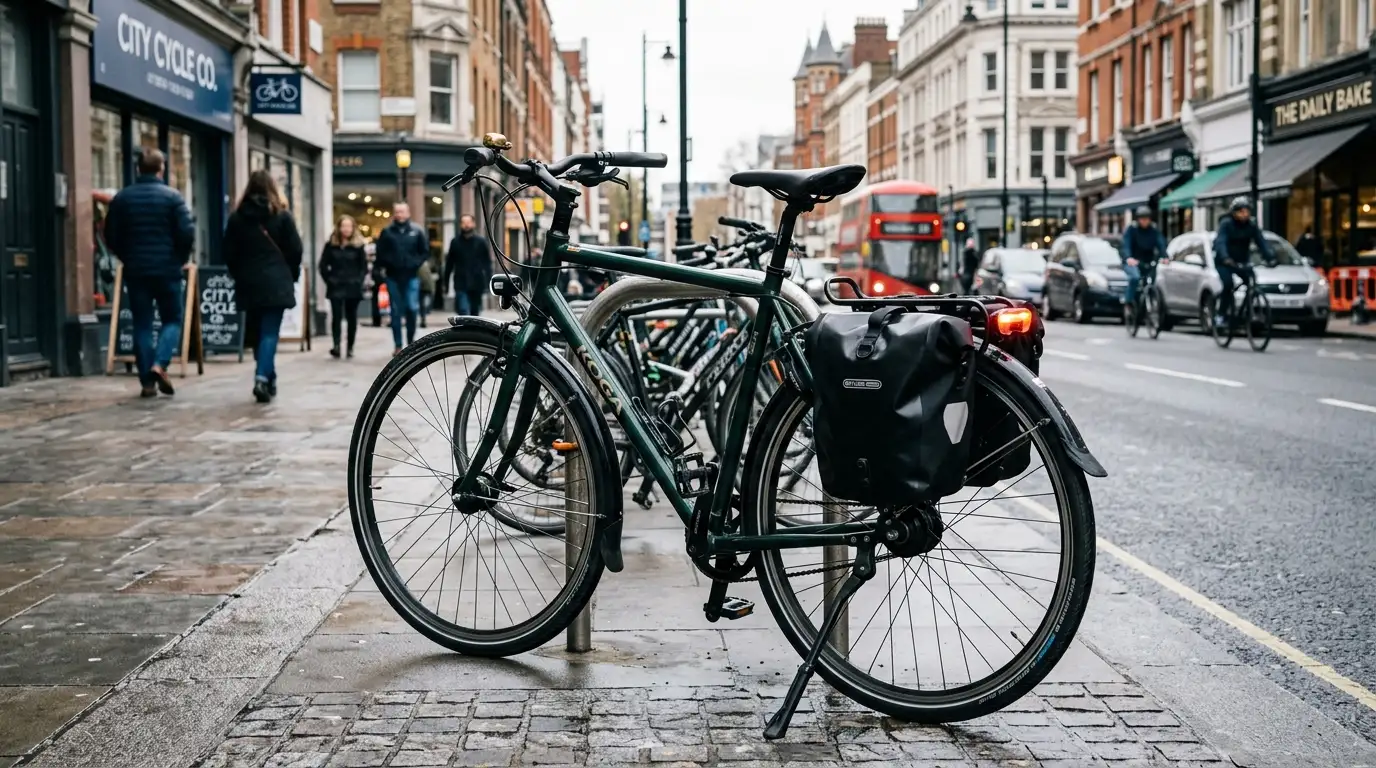
A commuter bike is a bicycle designed or equipped primarily for regular transportation, such as traveling to work, school, shops, appointments, or public transportation. Instead of focusing mainly on racing speed or off-road capability, a commuter bike generally prioritizes comfort, practicality, reliability, and useful everyday features.
The term does not describe one exact frame design. A dedicated city bike, hybrid, flat-bar bicycle, folding bike, or even some e-bikes can function as commuter bikes when their equipment and setup suit the rider’s daily journey. REI similarly notes that there is no single type of bike that is automatically best for commuting; the right choice depends on terrain, road conditions, distance and personal preferences.
If you’re asking what is a commuter bike, the simplest answer is this: it is a bicycle optimized for getting from one everyday destination to another comfortably and practically.
What Is a Commuter Bike Used For?
A commuter bike is used for transportation rather than primarily for competition or recreational trail riding.
Work and school
The most common use is traveling between home and work or school. A commuter setup can make repeated trips easier by providing a comfortable riding position, practical gearing, mudguard compatibility and a way to carry belongings.
A rack with panniers, for example, can carry a laptop, clothing, groceries or other items without putting all the weight on your back. REI recommends considering carrying systems such as racks, panniers and bags according to the length and demands of the commute.
Shopping and errands
A commuter bike can also replace short vehicle trips. Grocery shopping, visiting local businesses, going to appointments and traveling to public transportation stops are all examples of what a commuter bike can be used for.
For this type of riding, practicality can matter more than having the lightest possible frame.
Everyday urban transportation
Some people use their commuter bike almost like a personal transportation tool. The bicycle may be used several times a day rather than only for exercise.
That changes what matters when choosing one. Easy mounting, dependable brakes, useful carrying capacity, comfortable geometry, suitable tires and secure storage can be more important than maximum speed.
Cycling UK recommends considering the actual journey, route, terrain and luggage requirements when setting up a bicycle for commuting.
What Makes a Bike a Commuter Bike?
There is no single specification that turns a bicycle into a commuter bike. Instead, several practical characteristics commonly appear on bikes designed for everyday transportation.
Upright or moderately upright riding position
Many commuter bikes place the rider in a relatively upright position.
This can make it easier to look ahead, monitor traffic and ride comfortably during ordinary city journeys. Hybrid and commuter-style bicycles commonly use flat handlebars rather than the drop handlebars associated with performance-oriented road bikes.
An upright position is not mandatory, however. A bicycle with a more forward position can still be an effective commuter if it suits the rider and route.
Practical tires
Commuter bikes often use tires that balance efficiency, comfort and durability.
Very narrow performance tires can be fast on smooth pavement, but everyday roads may contain cracks, potholes, rough patches and debris. A somewhat wider road-oriented tire can provide a useful compromise for ordinary transportation.
The exact tire width should depend on the bicycle, rider, road surface and manufacturer specifications rather than a universal number.
Useful gearing
The ideal number of gears depends on the route.
A flat commute may not require a large range of gears, while a route with repeated climbs can benefit from lower gearing. Cycling UK notes that singlespeed and three-speed bikes can work on flatter routes, while derailleur gearing provides more flexibility for hills.
The important question is not simply, “How many gears does it have?” It is, “Does the available gearing make my route comfortable?”
Rack and fender compatibility
A commuter bike may have mounting points for a rear rack and mudguards.
A rack makes it easier to carry luggage, while fenders help protect the rider and bicycle from water and road spray. These features can make a major difference for someone riding regularly in wet conditions.
REI specifically identifies racks and fenders as useful equipment for commuters, while Cycling UK describes full-length mudguards as an important transport-cycling accessory.
Practical braking and visibility equipment
A commuter bike needs dependable braking appropriate to its intended riding conditions. Disc and rim brakes can both be found on commuter-oriented bicycles, and the choice depends on the bike and environment.
Lights and reflectors are also important for riders who travel in low-light conditions. Exact equipment requirements vary by jurisdiction, so commuters should check the rules where they ride.
Commuter Bike vs. Hybrid Bike
A commuter bike vs. hybrid bike comparison can be confusing because the categories overlap.
A commuter bike is defined primarily by its intended everyday transportation role. A hybrid bike is a broader bicycle category designed to combine characteristics useful for road riding and lighter mixed-surface riding.
That means a hybrid can absolutely be used as a commuter bike.
| Feature | Commuter bike | Hybrid bike |
|---|---|---|
| Main purpose | Everyday transportation | General-purpose riding |
| Riding position | Usually upright or relaxed | Usually upright or moderately forward |
| Pavement | Excellent | Excellent |
| Light gravel | Model dependent | Often suitable |
| Rack/fender mounts | Often practical | Depends on model |
| Weekend versatility | Moderate to high | Usually high |
| Best choice when | Transportation is the priority | You want one bike for several activities |
BikeRadar describes hybrids as general-purpose bicycles combining characteristics associated with road and mountain bikes, and notes that many hybrids are used for commuting.
The distinction is therefore about emphasis rather than a hard technical boundary.
If nearly every ride is transportation, a commuter-focused design may offer the practical equipment you need from the beginning. If you want to commute during the week and ride recreationally on paths or light gravel at weekends, a hybrid may provide more versatility.
Commuter Bike vs. Road Bike
The difference becomes clearer when comparing a commuter bike with a road bike.
Road bikes generally prioritize efficient paved-road riding, lower weight and aerodynamic positioning. Commuter bikes usually place greater emphasis on practicality, comfort, carrying equipment and compatibility with everyday accessories.
| Feature | Commuter bike | Road bike |
|---|---|---|
| Primary goal | Transportation | Efficient road riding |
| Handlebar | Usually flat | Usually drop |
| Riding position | Upright/relaxed | More forward |
| Tires | Generally wider | Generally narrower |
| Rack compatibility | Often available | Model dependent |
| Fender compatibility | Often available | Model dependent |
| Traffic-oriented comfort | Usually strong | Depends on model and rider |
| Long-distance speed focus | Moderate | Strong |
This does not mean a road bike cannot be a commuter.
A road bike can be an excellent commuting bicycle if the route is mostly paved and the rider values speed and efficiency. Conversely, a commuter bike may be preferable when carrying luggage, riding through poor weather or dealing with frequent stops is more important than maximizing speed.
REI makes the same broader point: the best commuting bicycle depends on terrain, road conditions, distance and personal preference rather than one universally correct bicycle type.
Is a Commuter Bike Good for Seniors?
A commuter bike can be suitable for older riders, but the important question is not simply age. Fit, balance, confidence, mobility, route conditions and the ability to operate the bicycle comfortably should guide the choice.
For someone searching what is a commuter bike for seniors, accessibility may be more important than performance.
A step-through or low-step frame can make mounting and dismounting easier because the rider does not need to swing a leg over a high top tube. Cycling UK’s bicycle-buying guidance specifically identifies town, low-step and step-through designs as options for beginners and people with mobility concerns.
Other useful considerations can include:
- A comfortable upright position
- Easy-to-reach controls
- Appropriate gearing for hills
- Stable handling
- A suitable frame size
- Tires appropriate for the local roads
- Easy mounting and dismounting
- A manageable overall weight
- Good lighting for the intended riding conditions
An e-bike may also be worth considering when hills, longer distances or physical effort are significant barriers. Cycling UK notes that electric assistance can make longer or hillier commutes more manageable.
The correct approach is to choose around the rider’s capabilities and route rather than assuming that every older cyclist needs the same bicycle.
How to Choose the Best Commuter Bike
There is no single best commuter bike for every cyclist.
The best option is the one that matches the actual journey.
Start with these five questions.
1. How far is the commute?
Short urban journeys place a strong emphasis on convenience and comfort.
Longer journeys may make gearing, riding position, tire choice, carrying capacity and overall efficiency more important.
Distance alone should not determine the bicycle. A short but extremely hilly commute can demand more from a bike than a longer flat route.
2. What is the terrain?
A flat route gives you more flexibility in gearing.
If your commute includes sustained climbs, look for gearing that gives you a genuinely useful low gear rather than choosing a bicycle simply because it has a large number of speeds.
3. What do you carry?
If you only carry a phone and wallet, you may not need a rack.
If you regularly transport a laptop, lunch, clothing or groceries, rack and pannier compatibility can make the bike much more practical.
Cycling UK recommends panniers and rack-mounted bags for carrying heavier commuting loads because they keep weight off the rider’s body.
4. What is the weather like?
If you ride through frequent rain, fenders become much more useful.
If you commute in darkness or poor visibility, appropriate lighting becomes important.
If the bicycle will regularly encounter wet and dirty conditions, ease of maintenance should also influence your choice.
5. Where will you store the bicycle?
Storage can affect your decision more than expected.
A folding bike may be useful where apartment space or public-transit integration is important. A lighter bicycle can be easier to carry upstairs. A secure garage or bicycle room gives you more freedom.
Cycling UK also recommends considering storage when selecting a bicycle.
What Is a Hybrid Bike?
A hybrid bike is a versatile bicycle that combines characteristics associated with different bicycle categories, particularly road and mountain bikes.
Most hybrids use flat handlebars and an upright or moderately upright riding position. They are commonly suitable for paved roads, commuting, recreational cycling and some light off-road surfaces, depending on the model.
That makes a hybrid a natural alternative when someone wants to know what is a commuter bike but does not want a bicycle dedicated primarily to transportation.
A hybrid is particularly useful when your riding changes from day to day. You might commute on pavement during the week and ride a park path or suitable gravel route on the weekend.
However, not every hybrid is equipped for commuting from the factory. Check whether the particular model supports the racks, fenders, tires and accessories you actually need.
What Does “Commuter” Mean in Cycling?
The commuter meaning is relatively simple: something intended or configured for regular travel between places, especially everyday journeys such as work, school or errands.
In cycling, “commuter bike” is therefore better understood as a practical category than as one strict mechanical design.
A hybrid can be a commuter. A folding bike can be a commuter. An e-bike can be a commuter. Some road bikes can be commuters.
The word describes the bicycle’s role in your transportation system.
What Is a Cruiser Bike?
A cruiser bike is a bicycle designed primarily around relaxed, comfortable recreational riding.
Cruisers commonly feature an upright riding position, wide or comfortable saddles, relaxed handling and styling influenced by classic bicycles. They are generally associated with casual riding rather than fast commuting or performance cycling.
A cruiser can be used for commuting, particularly for short, flat journeys, but its design may not provide all the practical features needed for frequent transportation.
For example, if you regularly carry work equipment or ride several miles each way, rack compatibility, gearing, tire choice and overall efficiency may matter more than cruiser styling.
What Does “Sports Bike” Mean?
This term needs clarification because sport bike usually refers to a motorcycle, not a bicycle.
In motorcycle terminology, a sport bike is a performance-oriented motorcycle designed around acceleration, braking, handling and cornering on paved roads or tracks. Sport bikes commonly use an aerodynamic fairing and a more aggressive riding position.
That is different from a commuter bicycle.
A commuter motorcycle is also different from a commuter bicycle, even though both can be used for transportation. If your search involves motorcycles rather than pedal bicycles, terms such as sport bike, cruiser motorcycle, touring motorcycle and commuter motorcycle have different meanings.
Can Any Bicycle Become a Commuter Bike?
In many cases, yes.
A bicycle does not need to carry a “commuter” label to perform commuting duties.
For example, a hybrid can become an effective commuter by adding appropriate fenders, lights, a rack and luggage. A road bike may work well for a long paved commute where speed is important. A folding bicycle can make sense when the journey includes trains or limited storage.
The key is matching the bicycle to the job.
That is why asking what is a commuter bike should be followed by a second question: What does my commute actually require?
A Simple Commuter Bike Decision Guide
Use this as a starting point:
| Your situation | Bicycle type to investigate |
|---|---|
| Short, flat urban trips | City or commuter bike |
| Daily pavement with luggage | Commuter bike |
| Commuting plus light recreational riding | Hybrid bike |
| Long paved commute where speed matters | Road or endurance road bike |
| Limited storage or train connections | Folding bike |
| Steep route or longer distance with less physical effort | E-bike |
| Easy mounting is a priority | Step-through/low-step bike |
| Mostly casual recreational riding | Cruiser bike |
These are starting points, not rigid rules. A test ride and proper sizing can be more valuable than choosing a bicycle solely from its category name.
What Should You Look for on a Commuter Bike?
Before buying, consider:
- Fit: The frame should suit your height, proportions and riding position.
- Gearing: Choose a range appropriate for the hills and distance on your route.
- Tires: Consider pavement quality, puncture resistance, comfort and rolling efficiency.
- Brakes: Choose a braking system appropriate for the bicycle and conditions in which you will ride.
- Rack mounts: Important if you regularly carry heavier items.
- Fender mounts: Particularly useful for wet-weather commuting.
- Lights: Essential equipment to consider when riding in darkness or poor visibility, subject to local requirements.
- Weight: Particularly important if you regularly carry the bike upstairs or need to load it onto another form of transportation.
- Storage: Consider where the bicycle will be kept at home, work or school.
- Maintenance: A simple, reliable setup can be valuable when the bicycle is transportation rather than an occasional hobby.
REI recommends thinking about the bike and its accessories together rather than choosing the bicycle independently of the commuting environment.
Commuting Is About the Whole System, Not Just the Bike
One of the easiest mistakes is to spend all your attention on the bicycle itself.
A successful commute also depends on the route, storage, weather protection, luggage, security and basic maintenance.
For example, a moderately priced bicycle with a good rack, suitable tires, reliable lights, fenders and a strong lock may be more useful for daily transportation than a lighter performance bicycle that cannot carry your belongings conveniently.
Route planning matters too. Cycling UK recommends testing potential routes and considering quieter roads and cycling facilities instead of simply following the same route you would drive.
The result is a more useful way to think about what is a commuter bike: it is not merely a bicycle with a particular shape. It is part of a transportation setup designed around repeated everyday journeys.
Final Answer
So, what is a commuter bike?
A commuter bike is a bicycle designed or equipped for regular transportation, especially journeys to work, school, shops and other everyday destinations. It commonly emphasizes comfort, practical gearing, dependable components, suitable tires and compatibility with accessories such as racks, panniers, fenders and lights.
There is no single perfect commuter design.
A dedicated commuter bike may be ideal for everyday urban transportation, while a hybrid can provide greater recreational flexibility. A road bike can make sense for a speed-focused paved commute, a folding bike can solve storage and public-transport problems, and an e-bike can help when distance or hills make conventional cycling difficult.
The best choice is therefore the bicycle that fits your route, distance, terrain, carrying needs, storage situation and riding preferences rather than simply the one with “commuter” printed on the frame.
FAQ’s
What is a commuter bike used for?
A commuter bike is mainly used for regular transportation, including commuting to work or school, shopping, errands and other everyday journeys. It prioritizes practical features such as comfort, useful gearing, carrying capacity and compatibility with accessories.
Is a hybrid bike a commuter bike?
A hybrid bike can function as a commuter bike, but the terms are not identical. A hybrid is a broad, versatile bicycle category, while “commuter” describes a bicycle’s transportation-oriented use.
Is a road bike good for commuting?
Yes. A road bike can be effective for a paved commute, particularly when the rider prioritizes speed and efficiency. However, a commuter or hybrid may offer more practical features for luggage, fenders, rough urban pavement and frequent stops.
What is the best commuter bike?
There is no universally best commuter bike. The appropriate choice depends on distance, terrain, road surface, luggage, weather, storage and personal comfort.
What is a commuter bike for seniors?
For older riders, a commuter bike with an accessible frame, comfortable riding position, appropriate gearing and easy-to-operate controls can be useful. Step-through or low-step designs may be particularly helpful for riders who find mounting and dismounting difficult.
What does commuter mean in cycling?
“Commuter” means the bicycle is intended or configured for regular transportation, such as traveling between home and work, school or other everyday destinations.
What is a cruiser bike?
A cruiser bike is a bicycle designed primarily for relaxed, comfortable recreational riding. It typically emphasizes an upright position and easygoing handling rather than speed or aggressive performance.
What does sports bike mean?
In motorcycle terminology, a sport bike is a performance-focused motorcycle designed for speed, acceleration, braking and cornering. It is different from a commuter bicycle.
Consistent, proactive inspection intervals extend vehicle reliability and resale value far more cost-effectively than reactive mechanical overhauls.

admin
admin is an automotive writer and technical editor at AutoSPrime, specializing in vehicle reliability and maintenance engineering.