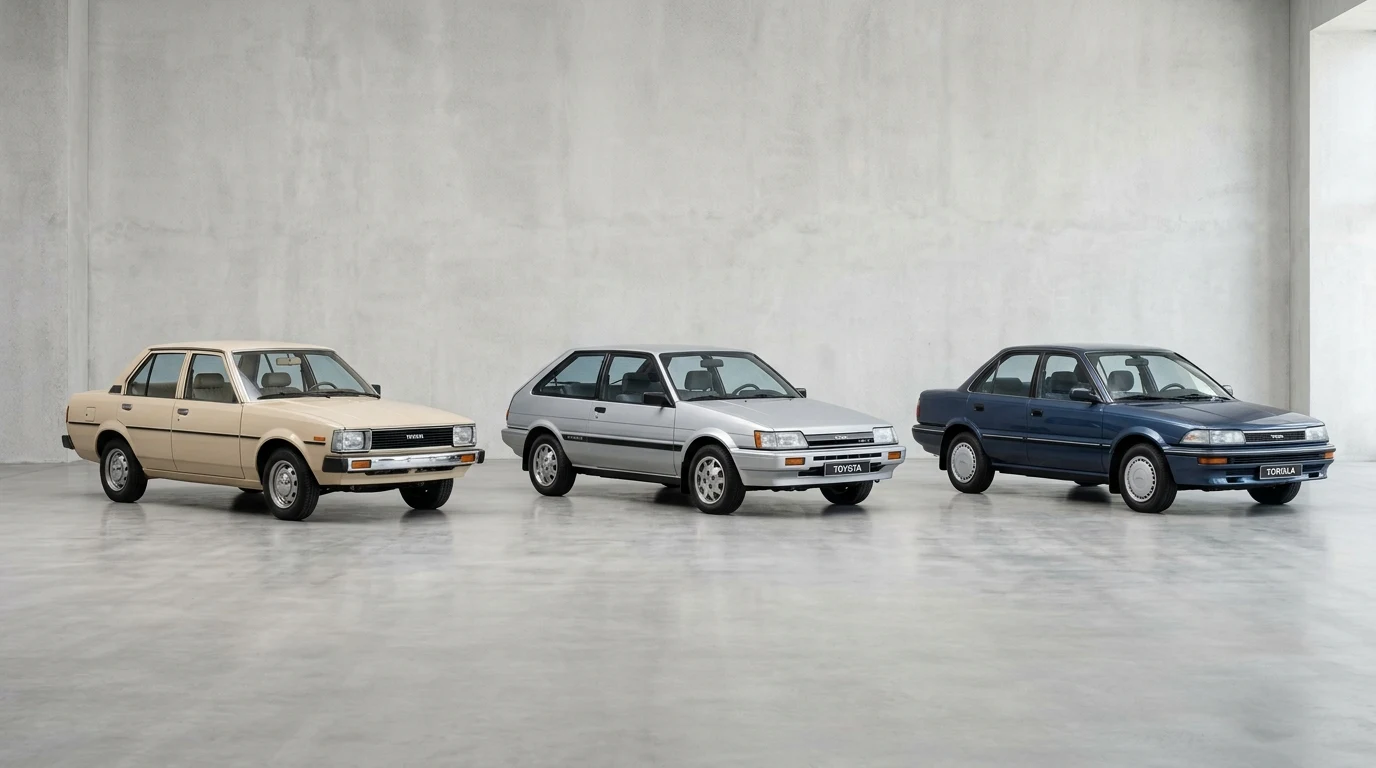
The 1980s Toyota Corolla was not one single model. The decade covered the fourth-generation E70, fifth-generation E80, and the beginning of the sixth-generation E90, with different body styles, engines, drivetrains, and market names depending on the country.
That distinction matters if you are searching for an 1980s Toyota Corolla for sale, trying to identify a Toyota Corolla 1982, or looking specifically for a Toyota Corolla E80 for sale. A 1982 Corolla, for example, belongs to the E70 generation, while the E80 arrived in 1983. By the end of the decade, newer E90 Corollas were already replacing the E80 in many markets.
The 1980s also produced some of the most interesting Corollas ever built. Alongside ordinary economy sedans and hatchbacks were sporty rear-wheel-drive models such as the AE86, known in different markets as the Corolla Levin, Sprinter Trueno, Corolla GT, or Corolla GT-S.
What Counts as an 1980s Toyota Corolla?
The simplest way to understand the decade is to divide it into three overlapping generations.
| Generation | Approximate production period | Key characteristic |
|---|---|---|
| E70, fourth generation | 1979–1983 | Traditional rear-wheel-drive Corolla family; some variants continued longer |
| E80, fifth generation | 1983–1987 | Main family models moved to front-wheel drive; sporty versions retained rear-wheel drive |
| E90, sixth generation | 1987–1991 | Newer generation appearing before the 1980s ended |
The exact model-year boundaries vary by country. Toyota’s own international history lists the fourth generation from 1979 to 1983, fifth generation from 1983 to 1987, and sixth generation from 1987 to 1991. Toyota’s U.S. historical material instead identifies the U.S. fourth generation as 1980–1983, fifth as 1984–1987, and sixth as 1988–1992.
This is why two Corollas from the same calendar year can sometimes appear in different historical references.
1980–1982: Fourth-Generation E70
If you are looking at a 1980 Toyota Corolla, 1981 Toyota Corolla, or Toyota Corolla 1982, you are generally dealing with the fourth-generation E70 family.
Toyota introduced the fourth-generation Corolla in 1979. Its design was more angular than the preceding generation, and the platform continued the traditional rear-wheel-drive layout across the main passenger-car range.
The E70 family was offered in multiple configurations and continued to serve different markets with different engines and equipment.
1983–1987: Fifth-Generation E80
The E80 arrived in May 1983 and represented one of the biggest changes in Corolla history.
Toyota moved the main family-oriented sedan from front-engine, rear-wheel drive to front-engine, front-wheel drive. The change created more usable interior space and reflected the broader shift toward front-wheel-drive compact cars.
The important exception was the sporty coupe family. Toyota retained rear-wheel drive for the Corolla Levin and Sprinter Trueno, creating the platform that would eventually become famous through the AE86.
1987–1989: Sixth-Generation E90
The sixth-generation Corolla appeared in 1987, meaning the 1980s ended with another generation already in production.
For a U.S. searcher, Toyota’s historical material generally places this generation in the 1988–1992 model-year period. In other markets, the generation began during 1987.
Therefore, an 1988 or 1989 Toyota Corolla should not automatically be assumed to be an E80. It may be an E90 depending on market and build/model year.
1980s Toyota Corolla Generations at a Glance
The following shortcut is useful when identifying a car:
- 1980–1982: Usually E70.
- 1983: Transition year; E70 and E80 references can both appear depending on market and production timing.
- 1984–1986: Predominantly E80 for the main passenger-car range.
- 1987: Transition between E80 and E90.
- 1988–1989: Generally E90 in markets such as the United States, although market-specific production and body-style differences exist.
The safest method is not to rely on the year alone. Check the chassis/model code, body style, engine, VIN information, and original-market specifications.
The 1980s Toyota Corolla E70
The E70 is especially important because it represents the earlier side of the 1980s Corolla story.
Toyota’s fourth-generation Corolla emphasized compact dimensions, efficiency, comfort, and improved driving stability. Its sharp, straight-lined styling suited the period, while Toyota offered a broad range of body configurations.
The E70 was also notable because different versions continued to be produced after the main passenger-car range began transitioning to the E80.
The 1982 Corolla
The Toyota Corolla 1982 is frequently confused with the E80 because both belong to the 1980s.
It is not an E80.
The 1982 passenger-car Corolla belongs to the fourth-generation E70 era. Toyota also introduced a Corolla station wagon in Japan in 1982, based on the earlier Corolla commercial-vehicle architecture.
This distinction becomes important when comparing prices or searching for parts. An advertisement describing a 1982 Corolla as an E80 should therefore be checked carefully.
A current used-car advertisement also tells you very little by itself about the car’s historical specification. A 1982 Corolla may have been modified, re-engined, repainted, imported from another country, or converted over its decades of use.
The Toyota Corolla E80
The Toyota Corolla E80 is the fifth-generation Corolla and one of the most important Corolla generations of the decade.
Toyota introduced it in 1983. The main family sedan adopted front-wheel drive, while the sporty coupe models retained rear-wheel drive.
This created an unusual situation: cars sharing the broader E80-era Corolla family could have very different drivetrains and personalities.
Toyota’s historical specifications for the Japanese-market 1983 sedan include 1.3-liter and 1.5-liter engines, with the representative cars using the 2A-LU and 3A-LU four-cylinder engines.
Other markets received different engine combinations, including 1.6-liter and diesel options.
Engines and Drivetrains
The E80 family used several Toyota four-cylinder engines depending on market and body style.
Common engine families associated with the generation include:
- 2A
- 2E
- 3A
- 4A
- 4A-GE
- 1C diesel
The important distinction is not simply engine size.
A 1.6-liter E80 could refer to a conventional front-wheel-drive Corolla or to a much more enthusiast-oriented rear-wheel-drive model using the 4A-GE.
That is one reason advertisements using only the words “1980s Toyota Corolla” are not enough to establish value.
1980s Toyota Corolla Hatchback Models
The phrase 1980s Toyota Corolla hatchback covers several different cars.
In Europe and other international markets, the E80 range included three- and five-door hatchback configurations. North America also received hatchback versions, including the Corolla FX.
The sporty rear-wheel-drive cars are a separate story.
Front-Wheel-Drive Hatchbacks
The E80 family introduced practical front-wheel-drive hatchback designs intended for everyday transportation.
These cars benefited from the same basic shift in engineering that affected the E80 sedan: the drivetrain layout was moved to the front, allowing Toyota to package the passenger compartment efficiently.
The result was a compact hatchback with straightforward mechanical engineering and practical cargo access.
Rear-Wheel-Drive AE86-Related Cars
The famous AE86 belongs to the same broad fifth-generation Corolla era but should not be treated as representative of every E80 Corolla.
The AE86 was a rear-wheel-drive sports-oriented model sold as the Corolla Levin or Sprinter Trueno in Japan. Related versions appeared under different names in other markets, including the Corolla GT and Corolla GT-S.
Its 4A-GE engine, five-speed manual transmission, lightweight construction, and rear-wheel-drive layout made it fundamentally different from an ordinary front-wheel-drive Corolla.
This difference has major implications for price.
A regular E80 family Corolla and a genuine, desirable AE86/GT/GT-S are not interchangeable when researching the classic-car market.
Why the AE86 Gets So Much Attention
The AE86 became particularly important among enthusiasts because it preserved rear-wheel drive and offered a high-revving four-cylinder engine at a time when many compact cars were moving toward front-wheel drive.
Toyota’s own historical material notes that the E80 coupe retained rear-wheel drive specifically to preserve sporty driving characteristics.
That makes the AE86 interesting historically, but it also creates a common research mistake: assuming every 1980s Corolla hatchback is an AE86.
It is not.
Always verify the chassis code.
How Much Does an 1980s Toyota Corolla Cost?
There is no single reliable 1980s Toyota Corolla price.
The value can change dramatically based on:
- Generation
- Exact chassis code
- Body style
- Engine
- Transmission
- Originality
- Rust
- Mileage
- Restoration quality
- Modifications
- Documentation
- Country
- Left- or right-hand drive
- Rarity
- Whether the car is a standard Corolla or a GT/GT-S/AE86-type model
Current listings illustrate the spread.
For example, U.S. listings recently included a 1985 Corolla sedan advertised around $6,599 and a 1987 Corolla FX16 advertised around $8,399, while a 1985 rear-wheel-drive SR5 hatchback was listed around $20,500. These are asking prices rather than guaranteed transaction values.
In the UK, current examples have included ordinary 1985 Corollas around £2,999 as well as a 1985 1.6 GT hatchback advertised around £15,995. A 1987 Corolla GT was also advertised around £17,500.
Those differences are not necessarily contradictions. They represent different versions, conditions, specifications, and sellers.
A Better Way to Think About Price
Instead of asking, “What is an 1980s Toyota Corolla worth?” ask:
Which 1980s Corolla is it?
Then ask:
What condition is it in?
Then:
How original is it?
Finally:
What market am I buying it in?
Classic-car databases can provide useful context, but their benchmarks should also be read carefully. For example, current E80 market data separates submarkets such as the Corolla GT-S, Sport SR5, Levin/Trueno/GT, and FX16 GT-S because these cars do not trade as one uniform market.
A headline E80 benchmark should therefore not be interpreted as the price of every ordinary E80 sedan or hatchback.
1980s Toyota Corolla for Sale: What to Look For
If your goal is to buy an 1980s Toyota Corolla for sale, start with identification rather than price.
A cheap car can become expensive if it needs major structural rust repair, difficult-to-find trim, extensive mechanical work, or a poorly executed restoration.
Verify the Exact Model
Ask the seller for:
- VIN or chassis number
- Model code
- Engine code
- Transmission type
- Original country of sale
- Registration documents
- Service records
- Previous restoration information
- Photographs of the underside
- Photographs of the engine bay
- Evidence of major modifications
For an imported car, ask specifically whether the current specification matches the original-market specification.
A seller calling a car an “AE86” does not by itself establish that it is a genuine AE86.
Check for Rust Before Cosmetic Modifications
On a decades-old car, structural condition deserves more attention than shiny paint.
Inspect:
- Sills and rocker panels
- Floor sections
- Wheel arches
- Suspension mounting points
- Subframes and chassis areas
- Spare-wheel well
- Door bottoms
- Windscreen surrounds
- Hatch or trunk seams
- Areas around weather seals
Fresh undercoating can make inspection more difficult, so look for evidence of previous repairs rather than assuming a clean-looking underside is original.
Inspect the Engine and Cooling System
An old Corolla may be mechanically simple, but age still matters.
Look for:
- Oil leaks
- Coolant leaks
- Overheating evidence
- Smoke from the exhaust
- Uneven idle
- Difficult cold starting
- Poor compression symptoms
- Damaged wiring
- Corroded electrical connections
- Non-original engine conversions
A test drive should include both cold-start behavior and operation after the engine reaches normal temperature.
Do Not Ignore the Interior
Interior parts can be surprisingly important on a classic car.
Check whether:
- Seats are original or retrimmed
- Dashboard plastics are cracked
- Switches work
- Instrumentation operates
- Door cards are complete
- Carpets have been replaced
- Headliner is intact
- Correct steering wheel and trim remain
A mechanically sound car missing rare interior components may be harder to return to factory condition than an ordinary mechanical repair.
Buying an E80 Corolla: Original or Modified?
Modification is not automatically a problem. The important question is whether the modifications match your intended use.
A modified E80 may have:
- Engine swaps
- Suspension changes
- Coilovers
- Larger brakes
- Aftermarket wheels
- Different seats
- Exhaust systems
- Fuel-system changes
- ECU changes
- Body kits
- AE86-related drivetrain conversions
For a project car, modifications can be part of the appeal.
For someone seeking an original historical example, however, extensive modifications can make the vehicle less useful as a factory-spec restoration candidate.
Before buying, decide which type of ownership you want:
| Goal | What to prioritize |
|---|---|
| Original classic | Factory specification and documentation |
| Weekend driver | Mechanical condition and usability |
| Restoration | Solid body and complete trim |
| Performance project | Chassis condition and quality of modifications |
| AE86/GT collector | Authenticity, specification and provenance |
The right inspection priorities change according to the intended use.
Common Ownership Considerations
A 1980s Corolla has some obvious advantages for a classic-car enthusiast: compact dimensions, relatively straightforward mechanical systems, and a huge historical footprint.
But age changes the ownership equation.
A car can have a reputation for reliability and still require substantial work after four decades.
Rubber components, hoses, seals, wiring, cooling-system parts, suspension components and fuel-system components all age even when mileage is low.
That is why a low-odometer example should not automatically be assumed to be mechanically superior.
A car that has been stored for years can have its own age-related problems.
Parts availability also varies considerably by model and country. Common mechanical components may be easier to source than model-specific trim, body panels, interior pieces, or rare drivetrain components.
Is an 1980s Toyota Corolla Practical Today?
It can be, but expectations should be realistic.
An ordinary 1980s Corolla can be enjoyable as a classic because its size and straightforward design make it approachable. However, it lacks the safety systems, refinement, corrosion protection, cabin technology, braking performance, sound insulation, and convenience features expected from a modern car.
That does not make it unsuitable.
It simply means the car should be evaluated as a four-decade-old vehicle rather than compared directly with a new Corolla.
For regular daily use, reliability depends heavily on the individual car’s maintenance history and current condition.
For weekend driving, shows, enthusiast events, restoration projects, or simply enjoying an older driving experience, the limitations may be much easier to accept.
Where to Find an 1980s Toyota Corolla for Sale
Availability varies dramatically by country.
Useful places to monitor include:
- Classic-car marketplaces
- General used-car marketplaces
- Toyota enthusiast communities
- Japanese classic-car specialists
- Auction platforms
- Local classified advertisements
- Brand-specific owners’ clubs
- Import specialists
Search using the exact model as well as the generic name.
For example, instead of searching only for:
“1980s Toyota Corolla for sale”
also try:
- Toyota Corolla E70
- Toyota Corolla E80
- Toyota Corolla AE80
- Toyota Corolla AE82
- Toyota Corolla AE86
- Toyota Corolla GT
- Toyota Corolla GT-S
- Toyota Corolla FX16
- Toyota Corolla SR5
- Toyota Corolla 1982
- Toyota Corolla 1985
- Toyota Corolla 1987
This reduces the chance of missing a relevant listing because the seller used a chassis code rather than the generic model name.
What Makes One 1980s Corolla More Desirable Than Another?
The answer depends heavily on the exact vehicle.
A standard family sedan, a practical hatchback, a GT/GT-S, and a genuine AE86 occupy different parts of the enthusiast market.
Rarity can matter, but condition and authenticity matter too.
For example, a rare car with extensive corrosion and questionable modifications may require more work than a common model in exceptional condition.
Likewise, an apparently expensive GT or AE86 should be checked carefully to confirm that its chassis, drivetrain and specification support the description.
Do not pay a premium based solely on badges, decals, engine swaps, or seller terminology.
Final Buying Checklist
Before buying an 1980s Toyota Corolla, confirm all of the following:
- Exact model year
- Exact generation
- Chassis/model code
- Original market
- Engine code
- Transmission
- Drive layout
- Body style
- VIN/chassis documentation
- Rust condition
- Previous accident repairs
- Engine condition
- Cooling system
- Transmission operation
- Suspension
- Brakes
- Electrical system
- Interior completeness
- Parts availability
- Modification history
- Registration/import status
- Current insurance requirements
- Total restoration or repair budget
Most importantly, compare the car with other examples of the same specification, not simply with every Corolla built during the 1980s.
Final Thoughts
The 1980s Toyota Corolla is best understood as a decade of transition rather than a single model. The E70 represents the earlier part of the decade, the E80 introduced the major shift to front-wheel drive for the mainstream Corolla, and the E90 arrived before the decade was over.
The E80 is particularly interesting because it combined ordinary front-wheel-drive family cars with rear-wheel-drive sporty models such as the AE86-related Corolla Levin and Sprinter Trueno.
That variety also explains why prices are so difficult to summarize. A basic 1980s Corolla, a clean original hatchback, an FX16, a GT-S, and a genuine AE86 can occupy very different markets.
If you are shopping for one, identify the generation and chassis first, inspect the structure second, verify originality and documentation third, and only then decide whether the asking price makes sense for that specific car.
FAQ’s
Is a 1982 Toyota Corolla an E80?
No. A 1982 Corolla belongs to the fourth-generation E70 era. Toyota introduced the fifth-generation E80 in May 1983.
What years are the Toyota Corolla E80?
The E80 fifth-generation Corolla was introduced in 1983 and ran through the middle of the decade, with market-specific production and model-year differences. Toyota’s global history identifies the fifth generation as 1983–1987.
Was the 1980s Toyota Corolla front-wheel drive?
Some were and some were not. The mainstream E80 Corolla moved to front-wheel drive, while sporty Corolla Levin and Sprinter Trueno coupe models retained rear-wheel drive. Earlier E70 models were also predominantly rear-wheel drive.
What is the most famous 1980s Toyota Corolla hatchback?
The AE86-related Corolla Levin/Sprinter Trueno is probably the best-known enthusiast version, but it should not be confused with every E80 hatchback. The E80 family included many ordinary front-wheel-drive models as well.
How much is an 1980s Toyota Corolla worth?
There is no single price. Current listings range from relatively inexpensive ordinary cars to substantially more expensive GT, GT-S and AE86-related examples. Condition, originality, specification, location and drivetrain can make a major difference.
Is the Toyota Corolla E80 the same as the AE86?
No. AE86 refers to a specific rear-wheel-drive Corolla/Sprinter chassis and related sporty models. The broader E80 generation contained numerous other Corolla variants.
Is an 1980s Toyota Corolla a good project car?
It can be, particularly when the body shell is solid and the car is complete. The biggest mistake is buying a cheap example without accounting for structural rust, missing trim, drivetrain problems and restoration costs.
Are 1980s Toyota Corolla parts still available?
Some mechanical parts remain relatively obtainable, but availability varies significantly by model, country and specification. Rare trim, body components and specific drivetrain parts can be considerably harder to find.
Consistent, proactive inspection intervals extend vehicle reliability and resale value far more cost-effectively than reactive mechanical overhauls.

admin
admin is an automotive writer and technical editor at AutoSPrime, specializing in vehicle reliability and maintenance engineering.