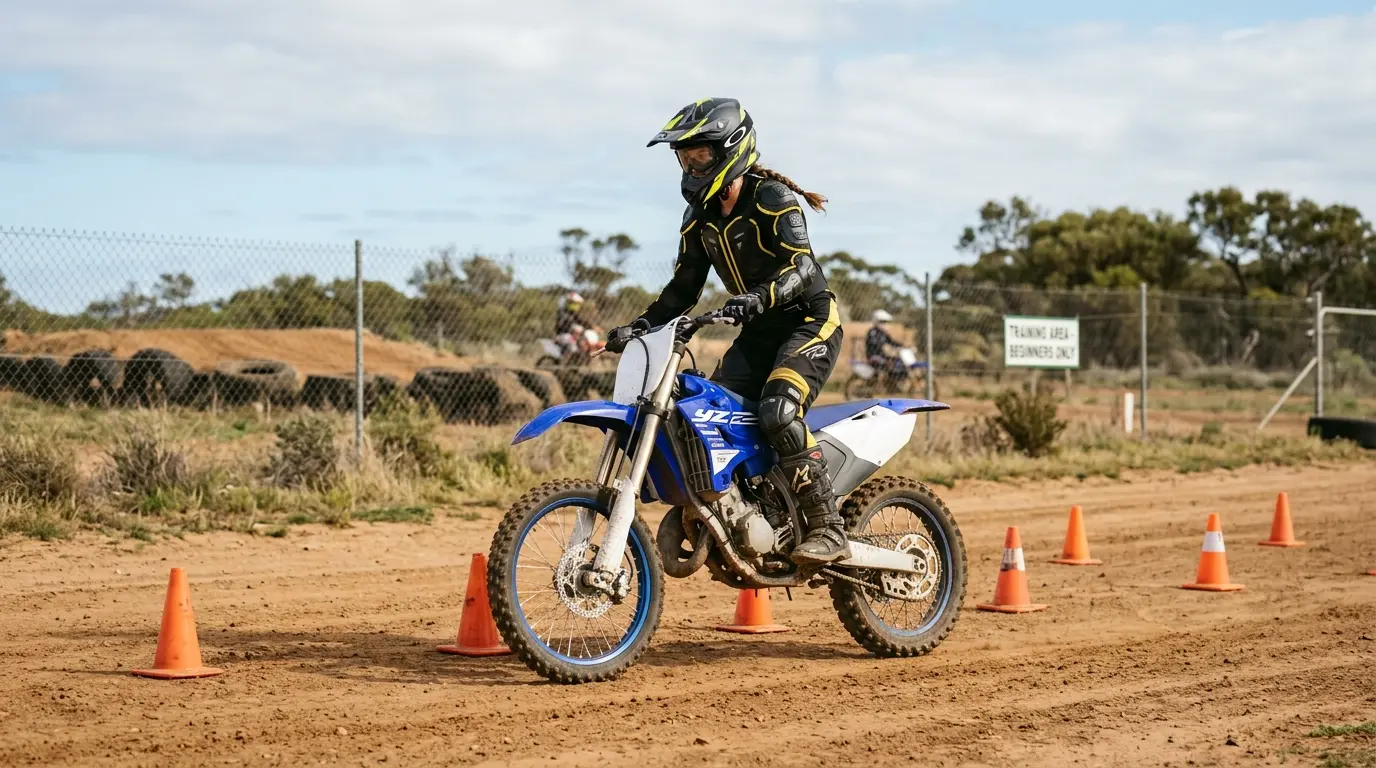
Learning how to ride a dirt bike is less about going fast and more about learning to control the motorcycle smoothly. Before you worry about jumps, deep trails, or high speeds, you need to become comfortable with the throttle, brakes, clutch, gears, balance, and body position.
A good beginner progression is simple: learn the controls while stationary, practice starting and stopping on flat ground, develop clutch and throttle coordination, learn to shift, and then gradually introduce turns, hills, and uneven terrain.
Dirt bikes are off-highway motorcycles, so they should be ridden in appropriate areas and on trails where riding is permitted. The Motorcycle Safety Foundation recommends hands-on dirt-bike training and teaches beginners basic controls, starting and stopping, riding posture, shifting, and risk management in a controlled environment.
If you are completely new, do not try to learn everything during your first ride. Build one skill at a time and increase the difficulty only when you can control the previous skill consistently.
What Is a Dirt Bike?
A dirt bike is a lightweight motorcycle designed primarily for off-road riding. Depending on the model, it may be designed for motocross tracks, trails, enduro riding, or general recreational off-road use.
Unlike a typical street motorcycle, a dirt bike is designed around features such as:
- Long-travel suspension
- Knobby off-road tires
- Lightweight construction
- High ground clearance
- Narrow bodywork
- Standing-friendly riding position
Different dirt bikes also have different transmissions and engine characteristics.
Some use a manual clutch and sequential transmission. Others, particularly many youth models, may use automatic or semi-automatic systems.
That difference matters when learning how to ride a dirt bike, because the controls and techniques you need depend on the motorcycle.
Before You Ride: Safety Comes First
Dirt biking involves real crash and injury risks. A beginner should learn in a controlled environment rather than immediately entering a difficult trail.
The Motorcycle Safety Foundation recommends a DOT-compliant helmet, goggles, long sleeves, long pants, over-the-ankle boots, and gloves. It also recommends riding only designated trails, avoiding riding alone on remote trails, and taking hands-on training.
California State Parks’ dirt-bike training guidance similarly covers protective equipment, pre-ride inspections, turning, hills, quick stops, swerving, and obstacles.
Wear Appropriate Protective Gear
At minimum, your off-road riding gear should include:
- Properly fitted motorcycle helmet
- Goggles
- Full-finger gloves
- Long pants
- Long-sleeved riding gear
- Over-the-ankle riding boots
Additional protection such as knee protection, elbow protection, and chest or body protection can provide further coverage.
Do not substitute ordinary sports equipment for motorcycle-specific protection when appropriate equipment is available.
Choose the Right Practice Area
Your first practice area should be:
- Flat or gently sloped
- Open
- Free of traffic
- Free of pedestrians
- Free of fixed obstacles
- Legally available for off-road riding
- Large enough to stop safely
Do not use a public road as your beginner practice area simply because it is empty.
The U.S. Forest Service states that OHVs, including dirt bikes, should be operated only on areas, roads, and trails designated as open to OHV use on the applicable National Forest land. Local rules can vary.
Check the Dirt Bike Before Riding
A quick pre-ride inspection can catch problems before they become riding problems.
Check:
- Tires and tire condition
- Wheels
- Brakes
- Chain
- Throttle operation
- Clutch operation
- Controls
- Fuel level
- Engine oil where applicable
- Coolant where applicable
- Loose fasteners
- Leaks
Your motorcycle’s owner’s manual should take priority for model-specific checks and starting procedures.
The MSF DirtBike School curriculum specifically includes motorcycle setup and a pre-ride inspection as part of beginner training.
Learn the Dirt Bike Controls
Before starting the engine, sit on the motorcycle and identify every control.
The exact arrangement can vary by model, but a typical manual dirt bike has:
| Control | Typical location | Function |
|---|---|---|
| Throttle | Right handlebar | Controls engine power |
| Front brake | Right handlebar | Operates front brake |
| Clutch | Left handlebar | Controls power transfer through the clutch |
| Gear shifter | Left foot | Selects transmission gears |
| Rear brake | Right foot | Operates rear brake |
| Kill switch | Handlebar | Stops the engine |
Spend a few minutes operating each control while the engine is off.
This may sound basic, but knowing where every control is before moving reduces the amount of attention you need to spend searching for controls once the bike is moving.
How the Throttle Works
The throttle is normally on the right handlebar.
Rolling the throttle toward you increases engine output. Rolling it forward reduces throttle input.
For beginners, the important skill is smooth throttle control.
Avoid suddenly twisting the throttle open.
A small movement can produce a significant change in acceleration depending on the motorcycle.
Keep your wrist in a position that allows you to make controlled throttle movements rather than repeatedly rotating your entire arm.
How the Clutch Works
A manual dirt bike normally has a clutch lever on the left handlebar.
Pulling the clutch lever toward the handlebar disengages the engine’s drive from the transmission.
As you gradually release it, the clutch begins transferring power to the rear wheel.
The point where this starts happening is commonly called the friction zone or engagement point.
Learning to feel this point is one of the most important steps in learning how to ride a dirt bike with a clutch.
How the Brakes Work
The front brake is normally controlled by the right-hand lever.
The rear brake is normally operated by the right foot.
Both brakes are important.
A beginner should practice smooth braking rather than treating either brake as an emergency-only control.
The MSF’s beginner curriculum includes controlled stops using both brakes and emphasizes smooth brake application.
How the Gear Shifter Works
On many manual dirt bikes, the gear shifter is operated by the left foot.
A common transmission arrangement is:
1st → Neutral → 2nd → 3rd → 4th → 5th
Some motorcycles have additional gears, so check your owner’s manual.
Do not assume every dirt bike has exactly the same transmission.
How to Start a Dirt Bike
Starting procedures vary by motorcycle, so follow the manufacturer’s instructions.
For a typical manual dirt bike:
- Make sure the motorcycle is stable.
- Confirm the transmission is in neutral or follow the manufacturer’s specified starting procedure.
- Turn the ignition on if applicable.
- Hold the clutch when required by the motorcycle’s starting system.
- Start the engine using the electric starter or kick starter.
- Allow the engine to settle according to the manufacturer’s instructions.
- Confirm that the controls are functioning normally before moving.
Do not immediately accelerate away.
First, make sure you understand where the throttle, clutch, and brakes are.
How to Ride a Dirt Bike for Beginners
The first objective is not speed.
Your first objective is controlled movement.
Start on flat ground and practice moving forward for a short distance before stopping.
Step 1: Sit Correctly
Sit in a position where you can comfortably operate the controls.
Keep your head up and look toward the area where you want to travel rather than staring directly at the front wheel.
MSF beginner training specifically teaches riders to keep their head and eyes up and look ahead.
Step 2: Select First Gear
If your bike has a manual transmission, select first gear according to the manufacturer’s procedure.
Keep the clutch engaged when necessary to prevent an unintended movement.
Step 3: Find the Friction Zone
Slowly release the clutch until you feel the motorcycle begin to pull.
At this point, the motorcycle is beginning to transfer engine power to the rear wheel.
Do not immediately release the clutch completely.
Practice feeling this engagement point.
Step 4: Add a Small Amount of Throttle
Use a small amount of throttle while continuing to release the clutch smoothly.
The exact throttle position depends on the motorcycle.
Do not copy a specific percentage of throttle from another bike because engine size, gearing, and throttle response differ.
Step 5: Get Both Feet Onto the Footpegs
Once the motorcycle is moving steadily, place your feet on the footpegs.
Avoid dragging your feet unnecessarily.
Keeping your feet on the pegs allows you to maintain a more consistent riding position and control the motorcycle.
Step 6: Practice Straight-Line Starts and Stops
Repeat this process:
Start → ride a short distance → slow down → stop → repeat.
Do not move to higher-speed riding until this feels predictable.
How to Ride a Dirt Bike With a Clutch
Learning how to ride a dirt bike with a clutch is mainly about coordinating three things:
Clutch + throttle + gear selection
The clutch should not be treated simply as an on/off switch.
Practice the Friction Zone
With the engine off, you can first familiarize yourself with the movement of the clutch lever.
Then, in an appropriate controlled practice area, start the motorcycle and practice moving a small amount of clutch lever travel at a time.
The goal is to recognize the point where the motorcycle begins to respond.
You should be able to:
- Pull the clutch in
- Release it smoothly
- Feel engagement
- Re-engage it when needed
- Avoid sudden movements
MSF’s DirtBike School specifically teaches clutch/throttle coordination and smooth starts and stops using the friction zone.
Starting From a Stop With a Clutch
For a typical manual bike:
- Pull the clutch lever in.
- Select first gear.
- Apply a small amount of throttle.
- Slowly release the clutch.
- Feel the friction zone.
- Continue releasing the clutch smoothly.
- Once fully engaged, accelerate normally.
If the engine stalls, do not panic.
The usual beginner causes include releasing the clutch too quickly or using insufficient throttle for the situation.
Reset, restart if necessary, and practice the same movement again.
How to Shift Up
Once you are moving, you can shift into a higher gear when appropriate for your speed and engine load.
A typical upshift involves:
- Reduce or momentarily close throttle input.
- Pull the clutch lever in.
- Shift up using the left-foot shifter.
- Release the clutch smoothly.
- Reapply throttle progressively.
The exact timing varies by motorcycle and riding conditions.
You do not need to reach a particular road speed before changing gears.
Instead, learn to recognize when the engine and motorcycle are telling you that another gear is appropriate.
How to Downshift
Downshifting requires similar coordination.
As you slow down:
- Reduce throttle.
- Apply the brakes as appropriate.
- Pull the clutch in.
- Select a lower gear.
- Release the clutch smoothly.
As you become more experienced, you can learn more advanced techniques such as matching engine speed during downshifts.
Beginners should first focus on smooth and predictable control.
How to Ride a Dirt Bike Without a Clutch
The phrase “ride a dirt bike without a clutch” can mean different things.
Some dirt bikes are designed with automatic or semi-automatic transmissions and do not require the rider to operate a conventional hand clutch.
That is fundamentally different from taking a manual motorcycle and simply ignoring its clutch.
Automatic Dirt Bikes
On a true automatic system, the transmission manages gear selection for the rider.
The rider generally focuses on:
- Throttle
- Brakes
- Steering
- Balance
- Body position
This can simplify the learning process because the rider has fewer controls to coordinate.
Semi-Automatic Dirt Bikes
Some youth or beginner motorcycles use a semi-automatic transmission.
These motorcycles may still require the rider to select gears with a foot shifter while eliminating the need for a hand-operated clutch.
Always check the specific motorcycle’s owner’s manual because transmission systems differ.
Can You Ignore the Clutch on a Manual Dirt Bike?
You should not treat a manual clutch motorcycle as though it were an automatic.
While experienced riders may use clutchless shifting in certain situations, beginners should learn the motorcycle’s intended clutch and shifting procedure first.
How to Ride a 2-Stroke Dirt Bike
Learning how to ride a 2-stroke dirt bike for beginners requires additional attention to throttle control and power delivery.
A two-stroke engine can have a different power-delivery character from a comparable four-stroke, and the difference varies considerably by engine design, displacement, gearing, tuning, and model.
Some two-stroke motorcycles can feel especially responsive when entering their stronger part of the powerband.
For a beginner, that means smooth throttle control becomes particularly important.
Start Slowly
Do not immediately try to discover the motorcycle’s maximum power.
Practice:
- Smooth starts
- Low-speed balance
- Controlled turns
- Braking
- Gear changes
- Gentle acceleration
Once those skills become predictable, gradually explore more of the motorcycle’s power.
Use the Clutch Deliberately
The clutch can help you manage how engine power reaches the rear wheel.
Learning to use it smoothly can be especially useful when riding at low speed, climbing, or managing changing traction.
Do not hold the clutch partially engaged continuously without understanding why you are doing it.
Learn the friction zone first, then gradually develop more advanced clutch control.
Body Position on a Dirt Bike
Body position has a major effect on motorcycle control.
When seated, maintain a balanced position and avoid locking your arms.
Your head should remain up, and your eyes should look toward the intended path.
When standing, use the footpegs as a primary support point and keep your knees and elbows appropriately bent.
MSF’s dirt-bike curriculum teaches correct posture, foot placement, standing posture, head and eyes up, and maintaining control of the motorcycle.
Why Standing Matters
Standing can give the rider greater freedom to move with the motorcycle over rough terrain.
It can also help when riding over bumps, uneven surfaces, and other obstacles.
But standing should not be the first skill you learn.
First become comfortable controlling the bike while seated on smooth, easy terrain.
Then practice standing at low speed in an appropriate area.
How to Turn a Dirt Bike
Start with large, gentle turns.
Do not immediately practice tight turns at speed.
Look Through the Turn
Your eyes should generally look toward where you want the motorcycle to go.
If you stare at an obstacle immediately in front of you, you may have difficulty choosing a smooth path around it.
Control Your Speed Before the Turn
Reduce speed before entering a turn rather than entering too quickly and attempting to solve the problem halfway through the corner.
Keep Your Movements Smooth
Abrupt throttle, brake, or steering inputs can disturb traction, especially on loose dirt.
As your skills develop, you can learn more advanced off-road cornering techniques.
How to Ride Over Hills
Hills require more preparation than flat ground.
Before attempting a climb, evaluate:
- Steepness
- Surface
- Available traction
- Obstacles
- Run-out area
- Whether you have enough space to stop safely
For a beginner, start with gentle slopes.
Use an appropriate low gear and maintain controlled momentum rather than attacking the hill at maximum speed.
If you lose control, your priority is to reduce risk and regain control rather than forcing yourself to continue.
Descending requires equally careful speed management.
Use appropriate braking and avoid entering a descent faster than you can safely manage.
California’s dirt-bike safety training specifically includes hill negotiation as a skill taught in formal training.
Riding Over Small Obstacles
Do not begin with large logs, jumps, rocks, or other difficult obstacles.
Start by learning to ride over very small, predictable changes in terrain.
Keep your eyes ahead and maintain a stable position.
As you become more experienced, you can learn techniques for larger obstacles from a qualified instructor.
Formal dirt-bike training programs can teach obstacle negotiation in a controlled environment.
Beginner Dirt Bike Practice Drills
You can make your practice much more effective by focusing on one skill at a time.
Drill 1: Start and Stop
Ride a short distance, stop, and repeat.
Focus on:
- Smooth clutch release
- Gentle throttle
- Controlled braking
- Stable balance
Drill 2: Friction-Zone Practice
Practice finding the clutch engagement point at very low speed.
The objective is to recognize what the motorcycle feels like when power begins reaching the rear wheel.
Drill 3: Straight-Line Braking
Ride at a low, controlled speed and practice smooth braking.
Learn how the front and rear brakes respond.
Drill 4: Wide Turns
Create a large circular or oval practice route.
Focus on looking ahead and maintaining smooth throttle control.
Drill 5: Figure Eights
Once wide turns are comfortable, gradually reduce the size of the turns.
Do not make them so tight that you lose control.
Drill 6: Standing Position
On appropriate smooth terrain, practice briefly standing on the footpegs while maintaining a controlled speed.
The purpose is to learn balance, not speed.
How to Ride a Dirt Bike for Adults
Adults can learn how to ride a dirt bike successfully even without previous motorcycle experience.
However, adult beginners sometimes make the mistake of assuming physical strength will compensate for a lack of technique.
It will not.
A heavier or more powerful dirt bike can be difficult to control regardless of the rider’s strength.
Start with a motorcycle that you can physically manage.
You should be able to reach and operate its controls appropriately. California State Parks advises following the manufacturer’s age and size recommendations and ensuring the rider can safely reach and operate the vehicle’s controls.
For adults, a useful progression is:
Controls → starts/stops → clutch → shifting → braking → turning → standing → easy trails
Do not skip several stages simply because you are physically capable of handling the motorcycle.
How to Ride a Dirt Bike for Kids
Children require additional attention to motorcycle size, power, supervision, and protective equipment.
Do not place a child on an adult-size dirt bike simply because the child can physically sit on it.
The Motorcycle Safety Foundation specifically advises supervising riders younger than 16 and never allowing youngsters to ride dirt bikes that are too tall or powerful for their capabilities.
The CPSC also emphasizes age-appropriate youth models for younger OHV riders and recommends hands-on training and protective equipment.
For children, the learning process should emphasize:
- Properly sized motorcycle
- Adult supervision
- Full protective equipment
- Flat beginner practice area
- Low-speed control
- Starting and stopping
- Braking
- Basic balance
- Gradual skill progression
The exact appropriate age and motorcycle depend on the specific machine, manufacturer recommendations, rider ability, and local requirements.
How to Ride a Dirt Bike as a Girl
There is no separate riding technique required because the rider is female.
The fundamentals of how to ride a dirt bike are the same: throttle control, braking, clutch operation where applicable, shifting, balance, body position, and terrain management.
What can differ is the rider’s physical size, strength, reach, experience, and the fit of the motorcycle and protective equipment.
A smaller rider may benefit from a motorcycle whose seat height, weight, controls, and power delivery are easier to manage.
The important consideration is fit and controllability, not gender.
Common Beginner Dirt Bike Mistakes
Choosing Too Much Power
A powerful motorcycle can make mistakes happen faster.
Choose a machine you can control rather than one chosen primarily for its engine size or top speed.
Looking Directly at the Front Wheel
Look ahead and plan your path.
Gripping the Handlebars Too Tightly
A relaxed grip can make it easier to make controlled steering inputs.
Using Too Much Throttle
A sudden throttle input can produce acceleration you did not intend.
Dumping the Clutch
Releasing the clutch abruptly can cause a stall or sudden acceleration depending on throttle input and motorcycle characteristics.
Braking Too Aggressively
Learn progressive braking before attempting emergency stops or high-speed riding.
Going to Trails Too Early
A trail adds variables such as rocks, roots, hills, mud, other riders, and unpredictable terrain.
Master basic controls first.
Riding Without Proper Equipment
Protective gear is not optional simply because you are riding slowly.
MSF recommends a helmet, goggles, gloves, long pants, long sleeves, and over-the-ankle boots for dirt-bike riding.
When Should You Move From a Practice Area to Trails?
There is no universal number of practice hours that guarantees readiness.
Instead, look at what you can actually control.
Before moving onto a more demanding trail, you should be comfortable with:
- Starting
- Stopping
- Braking
- Turning
- Shifting
- Clutch control if applicable
- Looking ahead
- Maintaining balance
- Handling basic changes in terrain
Start with an easy, legal trail appropriate for your experience.
Do not begin with technical terrain simply because you can operate the motorcycle on flat ground.
Ride Within the Trail Rules
Trail access varies by location.
Some public lands allow OHV use only on designated routes. The U.S. Forest Service notes that OHVs must stay on areas and trails designated as open to OHV use on applicable National Forest land.
Before riding, check:
- Local OHV regulations
- Trail closures
- Permit requirements
- Noise requirements
- Seasonal restrictions
- Vehicle requirements
- Whether motorcycles are permitted
Following trail rules also helps protect the riding areas themselves.
Should You Take a Dirt Bike Training Course?
For a complete beginner, hands-on instruction can be extremely useful.
Reading an article can explain what the controls do, but an instructor can observe your technique and correct problems while you practice.
The Motorcycle Safety Foundation’s DirtBike School is specifically designed to teach basic off-road riding skills and responsible riding practices, with training conducted in a controlled environment. MSF states that the course is available to riders six years old and above.
A structured course is particularly useful if:
- You have never ridden a motorcycle.
- You are unfamiliar with manual clutches.
- You are teaching a child.
- You are moving from street riding to off-road riding.
- You want to develop trail skills.
- You are unsure about your technique.
A Simple Learning Progression
If you want to remember only one sequence from this guide, use this:
- Wear proper protective gear.
- Learn every control while stationary.
- Practice starting and stopping.
- Learn the clutch friction zone if the bike has a manual clutch.
- Practice shifting.
- Learn smooth braking.
- Practice wide turns.
- Practice standing and body positioning.
- Introduce gentle hills and uneven terrain.
- Progress to easy trails.
- Learn advanced techniques from qualified instruction.
The objective is not to become fast immediately.
The objective is to make the motorcycle predictable.
Once the controls become familiar, you can spend more attention on terrain, positioning, traction, and riding technique.
Final Thoughts
Knowing how to ride a dirt bike is not just about twisting the throttle and changing gears. Good riding starts with control.
Learn the motorcycle’s controls, practice in an appropriate area, master smooth starts and stops, develop clutch control when required, and gradually introduce shifting, turning, standing, hills, and obstacles.
Choose a bike that fits the rider rather than simply choosing the most powerful machine available. For children especially, follow the manufacturer’s recommendations and use an age- and size-appropriate motorcycle.
Most importantly, do not rush the progression. A controlled beginner who understands the motorcycle and the terrain is in a much better position to develop advanced skills than a rider who tries to learn everything at once.
FAQ’s
How long does it take to learn how to ride a dirt bike?
It varies by rider. Someone with previous motorcycle experience may become comfortable with basic controls relatively quickly, while a complete beginner may need multiple practice sessions. There is no reliable number of hours that guarantees proficiency.
Is it hard to learn how to ride a dirt bike?
The basic controls can be learned progressively, but developing good off-road skills takes practice. Clutch control, braking, balance, terrain management, and body positioning become more demanding as riding conditions become more difficult.
How do you ride a dirt bike with a clutch?
Pull the clutch in, select the appropriate gear, apply a small amount of throttle, and gradually release the clutch through its friction zone. Continue practicing until you can start smoothly without stalling or accelerating unexpectedly.
Can you ride a dirt bike without using the clutch?
If the motorcycle has an automatic or semi-automatic transmission, it may not require a conventional hand-operated clutch. A manual dirt bike should not simply be treated as an automatic; beginners should learn its intended clutch and shifting operation.
Is a 2-stroke dirt bike good for beginners?
It depends on the motorcycle and rider. Some two-strokes can have responsive or abrupt power delivery, which may require additional throttle and clutch control. A beginner should choose a motorcycle whose power, weight, size, and controls are manageable.
Can adults learn to ride dirt bikes?
Yes. Adults without previous dirt-bike experience can learn the fundamentals through controlled practice and, ideally, hands-on instruction.
Can kids ride dirt bikes?
Children can ride appropriately designed youth dirt bikes when permitted by local rules and when properly supervised. The motorcycle must be appropriate for the child’s size and capability. MSF specifically warns against allowing young riders to use bikes that are too tall or powerful for them.
What gear do I need to ride a dirt bike?
At minimum, use a suitable helmet, goggles, gloves, long pants, long sleeves, and over-the-ankle boots. Additional protective equipment such as knee, elbow, and chest protection can provide further coverage.
Can I learn to ride a dirt bike on a road?
A dirt bike is designed primarily for off-road use. Riding on public roads may be prohibited or subject to specific legal requirements depending on the motorcycle and jurisdiction. Learn in a legal off-road area and check local regulations before riding.
Consistent, proactive inspection intervals extend vehicle reliability and resale value far more cost-effectively than reactive mechanical overhauls.

admin
admin is an automotive writer and technical editor at AutoSPrime, specializing in vehicle reliability and maintenance engineering.