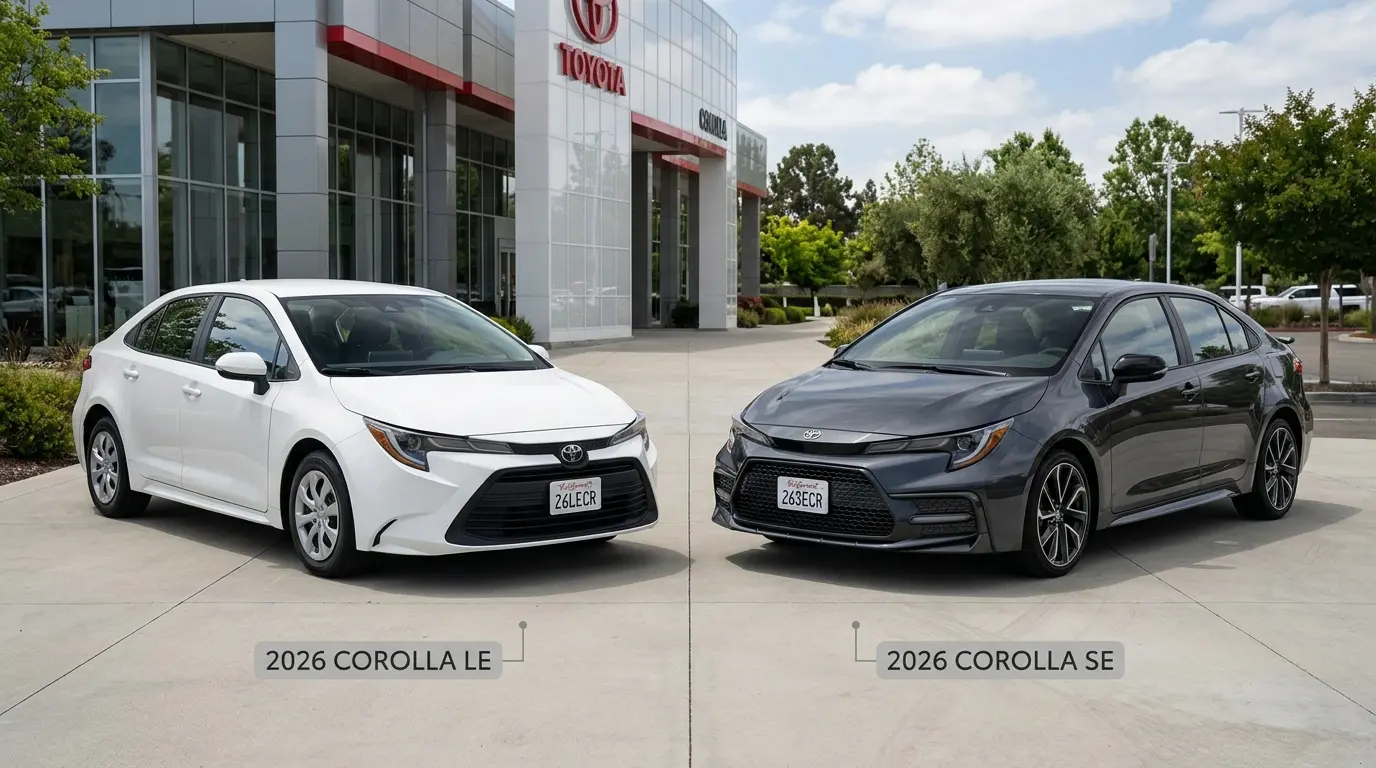
The Corolla LE vs SE comparison is mainly about equipment, driving character, styling, and price—not engine power. For the 2026 U.S.-market Toyota Corolla sedan, both gas trims use the same 2.0-liter four-cylinder engine, produce 169 horsepower and 151 lb-ft of torque, and send power through a Dynamic-Shift CVT to the front wheels.
The major differences appear in the suspension, wheels, drive modes, seats, exterior design, and available equipment. The 2026 Corolla LE starts at $23,125, while the SE starts at $25,565 before applicable destination charges, taxes, registration, dealer charges, options, and incentives.
That makes the LE vs SE decision more useful when viewed as an equipment and driving-character comparison rather than a simple engine upgrade.
Corolla LE vs SE at a Glance
Here is the basic 2026 comparison:
| Feature | 2026 Corolla LE | 2026 Corolla SE |
|---|---|---|
| Powertrain | 2.0L 4-cylinder | 2.0L 4-cylinder |
| Horsepower | 169 hp | 169 hp |
| Torque | 151 lb-ft | 151 lb-ft |
| Transmission | Dynamic-Shift CVT | Dynamic-Shift CVT |
| Drivetrain | FWD | FWD |
| EPA-est. city/highway MPG | 32/41 | 31/40 |
| Starting MSRP | $23,125 | $25,565 |
| Rear suspension | Torsion beam | Multi-link |
| Wheels | 16-in. steel standard | 18-in. alloy |
| Drive modes | Normal/Eco | Normal/Sport/Eco |
| Seats | Fabric | Sport seats with sport fabric inserts |
| Main character | More efficiency-focused | More sport-oriented |
Toyota’s 2026 specifications confirm that the gas LE and SE share the same 2.0-liter engine, CVT and front-wheel-drive layout. The LE uses a torsion-beam rear suspension, while the SE uses a multi-link rear suspension.
What Both Trims Share
The similarities are important because they prevent an easy misconception: moving from LE to SE does not buy a more powerful engine.
Both gas trims use Toyota’s 2.0-liter Dynamic Force four-cylinder engine with 169 horsepower and 151 lb-ft of torque. Both use the Dynamic-Shift CVT and front-wheel drive.
Both also have Toyota Safety Sense 3.0 and standard blind-spot monitoring with rear cross-traffic alert for the 2026 model year.
Both include wireless Apple CarPlay and Android Auto compatibility, an 8-inch Toyota Audio Multimedia touchscreen as standard, and a 7-inch digital gauge cluster.
In other words, the SE is not a higher-output Corolla engine. It is a sport-oriented version of the same basic gas Corolla.
Key Differences
Price
The biggest obvious difference is the starting price.
The 2026 Corolla LE has a base MSRP of $23,125, while the SE starts at $25,565. That creates a $2,440 difference in base MSRP before destination charges, taxes, registration, dealer fees, options, and other transaction-specific costs.
The price gap is therefore not a payment difference of exactly $2,440 for every buyer. Financing terms, incentives, dealer pricing, accessories, and taxes can change the amount paid.
When comparing actual cars at dealerships, compare the out-the-door price, not only the advertised MSRP.
Engine and Performance
This is one area where the LE and SE are essentially the same on paper.
Both use:
- 2.0-liter four-cylinder engine
- 169 horsepower
- 151 lb-ft of torque
- Dynamic-Shift CVT
- Front-wheel drive
The SE therefore does not provide a horsepower upgrade over the LE.
However, identical engine output does not mean the two trims have identical driving hardware.
The SE receives a multi-link rear suspension, while the LE uses a torsion-beam rear suspension. The SE also adds Normal, Sport and Eco driving modes, whereas the LE has Normal and Eco modes.
These changes are intended to give the SE a different driving character without turning it into a high-performance Corolla.
Fuel Economy
The LE has a small fuel-economy advantage.
Toyota lists the 2026 gas Corolla LE at an estimated 32 mpg city and 41 mpg highway, while the SE is rated at 31 mpg city and 40 mpg highway.
That is a difference of 1 mpg in both city and highway ratings.
The reason to consider this difference is not that the SE becomes dramatically more expensive to operate. Instead, it illustrates the trade-off: the SE’s larger wheels and sport-oriented equipment come with a small reduction in official fuel-economy ratings.
For someone who drives a high annual mileage and prioritizes efficiency, the LE’s rating is worth considering.
For someone who values the SE’s additional equipment and driving hardware, the small MPG difference may be less important.
Suspension and Driving Modes
The suspension is one of the more meaningful mechanical differences between the two trims.
The LE uses an independent MacPherson-strut front suspension with a torsion-beam rear suspension.
The SE uses the same basic front suspension architecture but adds a multi-link rear suspension.
The SE also includes three selectable driving modes:
- Normal
- Sport
- Eco
The LE has:
- Normal
- Eco
Sport mode changes the vehicle’s throttle and transmission behavior to provide a more responsive driving setting. It does not increase the engine’s maximum horsepower.
This distinction matters because calling the SE a “more powerful Corolla” would be inaccurate.
It is better described as a sport-oriented trim with different chassis and equipment specifications.
Wheels and Exterior Styling
The visual difference is immediately noticeable.
The 2026 Corolla LE comes with 16-inch steel wheels and covers as standard, while the SE receives 18-inch graphite-finished alloy wheels with P225/40R18 tires.
The SE also uses sport-oriented exterior details, including a sport mesh gloss-black grille, sport side rocker panels and a rear spoiler.
Toyota describes the LE’s exterior treatment as more refined, while the sport grades use a more aggressive design theme.
The larger wheels are not simply a styling decision. Tire size affects ride characteristics, replacement cost and the amount of sidewall between the wheel and road.
For buyers who regularly drive on rough roads, potholes and poorly maintained streets, tire and wheel specifications deserve attention beyond appearance.
Seats and Interior
The SE uses sport seats with sport fabric inserts.
The LE uses conventional fabric-trimmed seating.
Both retain the Corolla’s five-passenger configuration and 60/40 split-folding rear seat.
The SE’s seats are therefore one of the areas where the trim’s sport-oriented character is apparent even when the engine is identical.
The 2026 XSE goes further with SofTex-trimmed heated sport seats and an 8-way power driver’s seat, but those features should not be assumed to be part of the regular SE.
Technology
The standard multimedia setup is broadly similar.
Both LE and SE include an 8-inch Toyota Audio Multimedia touchscreen with wireless Apple CarPlay and Android Auto compatibility.
A 10.5-inch multimedia display is available on the SE and standard on the XSE according to Toyota’s 2026 brochure.
That distinction is important when comparing individual dealer vehicles.
Two SE listings can have different equipment if one has an optional package and the other does not.
For that reason, do not judge a specific Corolla only from the trim badge. Check the original window sticker or build sheet when possible.
Digital Gauge Cluster
For 2026, Toyota made a 7-inch digital gauge cluster standard on both LE and SE grades.
The XSE gets a larger 12.3-inch digital gauge cluster as standard, with the 2026 Toyota materials also identifying it as available on SE.
So if a listing advertises a Corolla SE with a 12.3-inch gauge cluster, that does not necessarily mean it is an XSE. Equipment packages and options can matter.
How Much More Does SE Cost?
For 2026, the base MSRP difference is:
$25,565 − $23,125 = $2,440
That extra amount corresponds to more than just cosmetic trim.
The SE adds or changes several important items, including:
- 18-inch alloy wheels
- Sport-oriented exterior styling
- Sport seats
- Sport driving mode
- Multi-link rear suspension
- Slightly different fuel-economy ratings
- Additional equipment depending on configuration
The best way to evaluate the price difference is to identify which of these features you would actually use.
If you mainly want a Corolla for straightforward commuting and care strongly about fuel economy and the lower purchase price, the LE provides the simpler configuration.
If the sport-oriented suspension, wheels, seats and styling are important to you, the SE represents a different specification rather than merely a cosmetic package.
Is the Corolla SE Actually Faster?
Not because of its engine.
The 2026 LE and SE have the same 169-hp, 2.0-liter engine and the same 151 lb-ft torque rating.
The SE can feel different because it has different suspension hardware and driving modes, but that should not be confused with an increase in maximum engine output.
Toyota’s XSE is also not simply a more powerful engine. It uses the same 2.0-liter gas engine, but adds further equipment and sport-oriented features.
For outright performance, the regular Corolla lineup should also be distinguished from the separate GR Corolla, which is a substantially different performance model.
Corolla Hybrid LE vs SE
The Corolla Hybrid LE vs SE comparison is different from the gas LE vs SE comparison.
For 2026, Toyota’s U.S. Corolla Hybrid uses a 1.8-liter four-cylinder engine combined with Toyota’s fifth-generation hybrid system. Toyota lists 138 net combined horsepower for the hybrid system.
The 2026 Hybrid lineup includes:
- Hybrid LE
- Hybrid LE AWD
- Hybrid SE
- Hybrid SE AWD
- Hybrid XLE
Hybrid LE
The 2026 Hybrid LE starts at $24,975 and is rated at an estimated 53 mpg city and 46 mpg highway in front-wheel drive.
An AWD version is available at a higher starting price.
Hybrid SE
The 2026 Hybrid SE starts at $27,415 and is rated at 50 mpg city and 43 mpg highway.
An AWD version is also available.
The Hybrid SE follows the same broad trim philosophy as the gas SE: sport seats, 18-inch alloy wheels and Normal/Sport/Eco driving modes.
The important point is that Hybrid LE vs SE should not be compared using the gas Corolla’s specifications.
The powertrain, transmission and fuel-economy figures are different.
Corolla LE vs SE vs XSE vs XLE
The trim names can become confusing because Toyota does not use exactly the same lineup for gas and hybrid models.
For 2026 in the U.S.:
| Trim | Powertrain | Starting MSRP | EPA-est. MPG |
|---|---|---|---|
| Corolla LE | Gas | $23,125 | 32/41 |
| Corolla SE | Gas | $25,565 | 31/40 |
| Corolla XSE | Gas | $28,840 | 31/38 |
| Hybrid LE | Hybrid | $24,975 | 53/46 |
| Hybrid SE | Hybrid | $27,415 | 50/43 |
| Hybrid XLE | Hybrid | $29,340 | 53/46 |
The most important detail is that there is no gas XLE in the 2026 U.S. Corolla sedan lineup. XLE is part of the hybrid lineup, while XSE is the higher gas trim.
Corolla LE vs SE vs XSE
Think of these as three gas-powered stages.
The LE emphasizes the basic Corolla formula.
The SE adds sport-oriented chassis, styling and equipment.
The XSE adds additional premium equipment, including the 12.3-inch digital gauge cluster and SofTex-trimmed heated sport seats.
Corolla LE vs SE vs XLE
This comparison needs more care.
The 2026 Hybrid XLE is not simply a gas SE with additional luxury equipment. It belongs to the hybrid powertrain lineup and has different efficiency, transmission and drivetrain characteristics.
If a listing simply says “Corolla XLE,” check the model year and powertrain before comparing it with an SE.
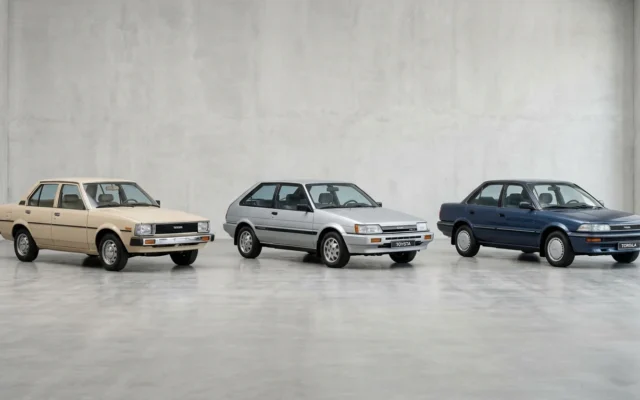
What About 2025, 2024, 2021 and 2020 Corollas?
This is one of the most important points for used-car shoppers.
A Corolla LE vs SE comparison is not automatically transferable between model years.
For example, Toyota’s 2025 Corolla lineup included LE, SE, FX and XSE gas grades, along with several hybrid grades. The 2025 gas LE started at $22,325, while the SE started at $24,765.
The 2024 Corolla had LE, SE, Nightshade and XSE gas grades, with different pricing and equipment.
The 2020 Corolla also had important differences from the current car. Toyota’s 2020 documentation, for example, lists an SE with a 2.0-liter engine and also describes a six-speed manual SE configuration.
Therefore, if you are researching:
- 2020 Corolla LE vs SE
- 2021 Corolla LE vs SE
- 2023 Corolla LE vs SE
- 2024 Corolla LE vs SE
- 2025 Corolla LE vs SE
- 2026 Corolla LE vs SE
you should verify the exact model-year brochure rather than assuming the latest specifications apply.
This is especially important when buying used.
Corolla L vs LE vs SE
If you are searching for Corolla L vs LE vs SE, the model year is essential.
Toyota has used the L designation on previous Corolla model years, but the current U.S. 2026 Corolla sedan lineup starts with LE rather than L.
That means a comparison involving the Corolla L usually points to an older model year.
The L, LE and SE hierarchy should therefore be evaluated according to the exact year being considered.
Do not use a 2017, 2020 or 2021 L/LE/SE feature list as a substitute for a 2026 comparison.
Corolla Cross LE vs SE Is a Different Comparison
The Corolla Cross LE vs SE search refers to a different vehicle.
The Corolla Cross is a crossover rather than the regular Corolla sedan.
It has its own trim structure, dimensions, suspension configurations, powertrains and equipment.
The word “Corolla” appears in both vehicle names, but a Corolla Cross LE should not be compared directly with a Corolla sedan LE simply because both carry the LE badge.
If you are shopping for the crossover, use Corolla Cross-specific specifications.
What Should You Check When Comparing a Used Corolla LE and SE?
If you are shopping for a used Corolla, start with the model year and VIN.
Then verify:
- Exact trim
- Model year
- Gas or hybrid powertrain
- FWD or AWD
- Original equipment
- Optional packages
- Wheel and tire specification
- Accident history
- Service history
- Remaining warranty coverage
- Recall status
- Actual out-the-door or transaction price
This matters because a used SE may have optional equipment that another SE does not have.
Likewise, a used LE may have an equipment package that makes it much closer to an SE in everyday convenience.
The trim badge is the starting point, not the entire specification.
The Practical Difference
The easiest way to understand the 2026 comparison is to separate core mechanical performance from trim character.
The LE and SE have the same gas engine, horsepower, torque, CVT and FWD layout.
The SE changes the driving and ownership experience through its multi-link rear suspension, larger wheels, sport seats, additional drive mode and sport-oriented exterior design.
The LE also has a small fuel-economy advantage.
The price difference is $2,440 in base MSRP before other transaction costs.
That means the real question is not simply whether one trim has a better engine. It is whether the SE’s additional hardware and equipment correspond to what you want from the car.
For a buyer comparing actual vehicles, the most useful final step is to compare the window stickers and out-the-door prices of the specific LE and SE examples being considered.
That approach also prevents older model-year specifications, dealer packages and hybrid equipment from being mixed together.
Conclusion
The Corolla LE vs SE comparison is relatively straightforward for the 2026 U.S.-market gas sedan: both use the same 2.0-liter, 169-hp engine and front-wheel-drive CVT powertrain, but the SE adds a sport-oriented chassis, larger wheels, sport seats, Sport mode and different exterior equipment.
The LE starts at $23,125, while the SE starts at $25,565. The LE also has slightly higher EPA-estimated fuel economy.
For hybrid shoppers, the comparison changes because the Hybrid LE and Hybrid SE use Toyota’s hybrid powertrain and can be equipped with AWD.
For used-car shoppers, always identify the model year first. A 2020 or 2021 Corolla LE vs SE comparison can differ substantially from the 2026 version, so current trim information should not be applied retroactively.
FAQ’s
What is the main difference between the Corolla LE and SE?
For the 2026 U.S.-market Corolla sedan, both trims use the same 2.0-liter, 169-hp engine and CVT. The SE adds sport-oriented equipment, including 18-inch alloy wheels, sport seats, Sport driving mode and a multi-link rear suspension.
Is the Corolla SE faster than the LE?
The SE does not have a more powerful engine. Both 2026 gas trims produce 169 horsepower and 151 lb-ft of torque. The SE’s different suspension and Sport mode can change how the car feels to drive, but they do not increase the engine’s rated output.
How much more does the 2026 Corolla SE cost than the LE?
The 2026 Corolla LE starts at $23,125, while the SE starts at $25,565, creating a $2,440 difference in base MSRP before destination charges, taxes, fees, options and incentives.
Does the Corolla LE or SE get better gas mileage?
The 2026 gas Corolla LE has the higher official EPA-estimated rating at 32 city/41 highway mpg, compared with 31 city/40 highway mpg for the SE.
Does the Corolla SE have a different suspension?
Yes. The 2026 gas LE uses a torsion-beam rear suspension, while the SE uses a multi-link rear suspension.
Does the Corolla LE have Sport mode?
The 2026 gas LE has Normal and Eco modes. Sport mode is included on the SE.
What is the difference between Corolla Hybrid LE and SE?
Both use Toyota’s hybrid powertrain, but the Hybrid SE adds sport-oriented equipment such as 18-inch alloy wheels, sport seats and Sport mode. The Hybrid LE emphasizes efficiency and has higher EPA-estimated fuel-economy ratings.
Is there a 2026 Corolla gas XLE?
Not in the U.S. Corolla sedan lineup. The 2026 gas lineup consists of LE, SE and XSE, while Hybrid models include Hybrid LE, Hybrid SE and Hybrid XLE.
Is Corolla Cross LE vs SE the same comparison?
No. The Corolla Cross is a separate crossover model with its own trim structure and specifications. A Corolla Cross LE should not be treated as the same vehicle as a Corolla sedan LE.
Does the Corolla LE vs SE comparison change by model year?
Yes. Equipment, prices, engines, transmissions and available packages can change between model years. Always check the brochure or official specifications for the exact year you are considering.
Consistent, proactive inspection intervals extend vehicle reliability and resale value far more cost-effectively than reactive mechanical overhauls.

admin
admin is an automotive writer and technical editor at AutoSPrime, specializing in vehicle reliability and maintenance engineering.