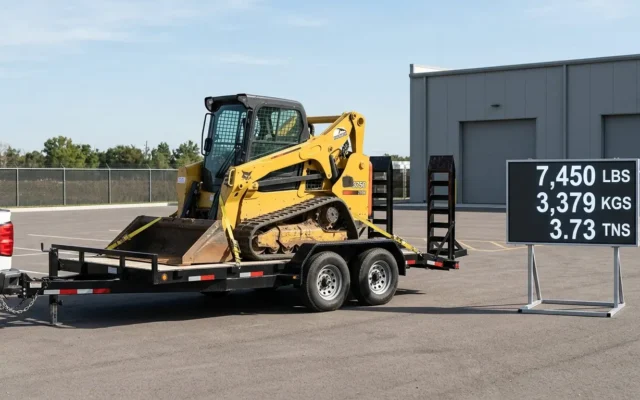
A backhoe is a digging machine with a bucket mounted on the end of a hydraulic arm. In everyday construction terminology, however, the word “backhoe” usually refers to a backhoe loader: a tractor-like machine with a loader bucket at the front and a backhoe digging arm at the rear.
That combination is what makes the machine useful. The front bucket can scoop, lift and move material, while the rear attachment can dig trenches, holes and foundations. Manufacturers such as Caterpillar and Bobcat describe backhoe loaders as versatile machines capable of both loading/material-handling and excavation work.
A backhoe is therefore not simply a smaller excavator. It is a multi-purpose machine designed to perform several types of work without bringing separate loading and digging equipment to every job.
What Is a Backhoe Loader?
A backhoe loader is a wheeled construction machine that combines two primary functions:
- A front loader for scooping, lifting and moving materials
- A rear backhoe for digging and excavation
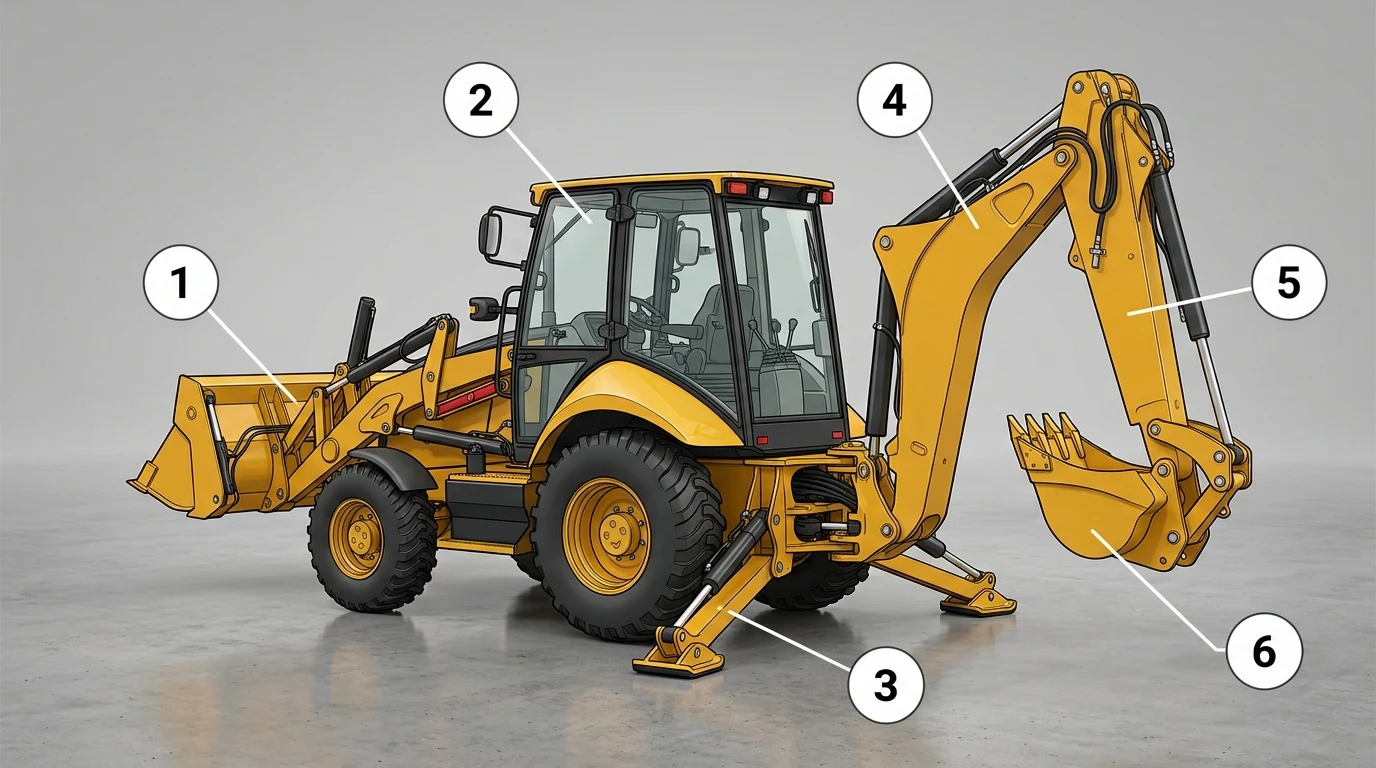
The rear digging assembly consists of a boom, dipper or stick, hydraulic cylinders and a bucket. Stabilizers are commonly deployed while digging to help support the machine.
The front and rear equipment give the operator two different working functions from one machine. Bobcat describes its backhoe loaders as machines that can load and carry material with the front loader while digging holes and trenches with the rear backhoe.
This is also why the terms backhoe, backhoe loader, loader backhoe, and tractor-loader-backhoe can sometimes appear interchangeably in equipment discussions.
Strictly speaking, the backhoe is the rear digging mechanism, while the backhoe loader is the complete machine.
What Does a Backhoe Look Like?
A typical backhoe loader has three major areas:
| Part | Main function |
|---|---|
| Front loader bucket | Scooping, lifting and moving material |
| Tractor-like chassis and cab | Provides power, mobility and operator controls |
| Rear backhoe | Digging trenches, holes and foundations |
The machine normally travels on wheels rather than crawler tracks. This allows many backhoe loaders to move between nearby work areas without being transported in the same way as larger crawler excavators.
Some machines use four-wheel drive or other drivetrain configurations to improve traction on difficult surfaces.
The rear assembly can also be equipped with different work tools depending on the machine and attachment system.
What Is a Backhoe Used For?
A backhoe is used when a job requires a combination of excavation, material handling and mobility.
Caterpillar lists applications including general construction, demolition, excavation, landscaping, breaking asphalt and paving.
Digging trenches
One of the most common backhoe applications is trenching.
A backhoe can excavate trenches for:
- Water lines
- Drainage
- Electrical utilities
- Gas and other services
- Irrigation
- Foundations
The rear bucket is particularly useful when the operator needs to excavate a relatively narrow trench rather than remove large quantities of earth across a huge area.
Digging foundations and holes
Backhoes can excavate foundations, post holes and other ground openings.
The appropriate bucket size and digging configuration depend on the required width, depth and soil conditions.
Loading and moving material
The front loader makes the machine useful after excavation.
An operator can use it to move:
- Soil
- Gravel
- Sand
- Demolition debris
- Mulch
- Other loose materials
This dual function is one of the defining characteristics of a backhoe loader.
Landscaping and site preparation
Backhoes can assist with tasks such as grading, moving soil, preparing areas for construction and performing smaller excavation jobs.
Their combination of digging and loading equipment can be useful when a project does not justify bringing several larger machines to the site.
Road and utility work
Backhoe loaders are also used in road maintenance, utility construction and municipal work.
For example, a crew working on a utility repair may need to excavate the ground, move the removed material and later backfill the excavation. A backhoe loader can perform several of those tasks using the same machine.
How Does a Backhoe Work?
A backhoe uses hydraulic power to move its loader and digging components.
When digging with the rear attachment, hydraulic cylinders move the boom, dipper and bucket. The operator positions the machine, deploys the stabilizers when required, lowers the digging equipment and uses the controls to remove material.
The digging action is different from simply pushing a bucket forward. The rear bucket is designed to pull material toward the machine as the hydraulic arm works through its digging cycle.
After excavation, the front loader can often be used to move material around the site.
The exact control layout varies between manufacturers and models. Modern backhoes may use joystick controls and electronic systems, while other machines use more traditional hydraulic controls.
What Is a Backhoe Operator?
A backhoe operator is the person responsible for controlling and operating the backhoe loader.
The operator may control:
- Machine travel
- Front loader movement
- Rear boom and dipper movement
- Digging bucket movement
- Stabilizers
- Hydraulic attachments
- Other machine functions
The job involves more than moving the controls. The operator needs to position the machine appropriately, maintain awareness of people and objects around the equipment, work within the machine’s operating limits and perform the required excavation or material-handling tasks.
Training and qualification requirements vary according to the country, employer, equipment and work environment. For workplace safety information in the United States, equipment operators should refer to applicable OSHA requirements and manufacturer instructions rather than relying on a general internet guide.
Backhoe vs. Excavator: What Is the Difference?
A backhoe loader and an excavator can both dig, but their designs are different.
A backhoe loader combines a front loader and rear digging attachment, whereas a conventional excavator is primarily designed around excavation and typically has its digging equipment mounted on a rotating upper structure.
| Feature | Backhoe loader | Excavator |
|---|---|---|
| Front loader bucket | Yes | Usually no |
| Dedicated rear digging arm | Yes | Yes |
| Main strength | Versatility | Excavation |
| Material loading | Strong capability | Usually requires a different attachment/configuration |
| Road mobility | Often well suited to traveling between nearby work areas | Often transported between sites |
| Rotation | Limited compared with an excavator | Typically 360-degree upper-structure rotation |
| Typical role | Multi-purpose construction and utility work | Excavation, trenching, heavy digging and specialized work |
This does not mean that one machine is universally better.
The appropriate machine depends on the project. Backhoe loaders are useful when the same machine needs to perform both digging and loading tasks. Excavators become more attractive when excavation itself is the dominant requirement, particularly on larger or more demanding projects.
Industry comparisons similarly identify machine size, rotation, mobility and intended application as important differences between the two.
What Is a Backhoe Tractor?
A backhoe tractor, often called a tractor-loader-backhoe (TLB), is a tractor-based machine equipped with a rear backhoe and usually a front loader.
The terminology can be confusing because the machine has characteristics of several equipment categories.
Think of it this way:
Tractor + front loader + rear backhoe = tractor-loader-backhoe
Modern dedicated backhoe loaders are purpose-built construction machines, while some agricultural or compact tractors can also accept backhoe attachments.
That distinction matters when comparing machines. A compact tractor with a backhoe attachment is not necessarily equivalent in capability to a full-size construction backhoe loader.
What Is a Backhoe Called?
Depending on the country and context, you may hear several names:
- Backhoe
- Backhoe loader
- Loader backhoe
- Tractor-loader-backhoe
- TLB
- Backhoe tractor
- Loader excavator
- Tractor excavator
- Digger
The exact terminology varies by region and manufacturer.
In everyday North American construction conversations, “backhoe” commonly means the complete backhoe loader, even though technically the backhoe is the rear digging mechanism.
In some markets, brand names can also become informal terms for the machine. For example, JCB is strongly associated with backhoe loaders, and the company continues to manufacture the 3CX and 4CX backhoe-loader range.
What Is a Backhoe Excavator?
“Backhoe excavator” is an informal or overlapping term rather than the clearest technical name for the complete machine.
A backhoe is an excavating attachment or digging mechanism that pulls a bucket toward the machine. A backhoe loader combines that digging mechanism with a front loader.
A conventional excavator is a different machine configuration.
Therefore, if you are searching for a machine with a front loader bucket and rear digging arm, backhoe loader is generally the more precise term.
What Size Is a Backhoe Bucket?
There is no single standard backhoe bucket size.
Buckets are available in different widths and capacities to suit the machine and job. Cat’s current backhoe range, for example, lists rear bucket options including 9-inch, 12-inch, 24-inch and 30-inch buckets on certain configurations, along with other bucket types and attachments.
Bucket selection depends on:
- Required trench width
- Required digging depth
- Soil conditions
- Machine size
- Hydraulic capability
- Desired bucket capacity
- Material being excavated
A narrow bucket can be useful for utility trenching, while a wider bucket can remove more material per pass.
However, the biggest bucket is not automatically the right choice. The bucket must be compatible with the machine and appropriate for the excavation task.
Common Backhoe Attachments
The rear and front ends of many modern backhoe loaders can accept work tools.
Depending on the model and attachment system, available tools may include:
- Different digging buckets
- Hydraulic hammers
- Augers
- Forks
- Brooms
- Compaction equipment
- Material-handling tools
- Grapples and other specialized tools
Caterpillar, for example, lists buckets, forks, material-handling arms, augers, hammers, brooms, cold planers and vibratory plate compactors among its backhoe-loader work tools.
Attachment compatibility is model-specific, so an attachment designed for one machine should not automatically be assumed to fit another.
What Are the Main Advantages of a Backhoe?
The main advantage is versatility.
Instead of using one machine primarily for excavation and another for loading, a backhoe loader can perform both functions.
Other useful characteristics include:
Mobility: Wheeled backhoes can travel between work areas without operating like a crawler excavator.
Multi-purpose capability: The front and rear equipment allow different tasks to be completed with one machine.
Utility work: Their combination of digging, loading and mobility makes them useful for many utility and municipal applications.
Attachment flexibility: Compatible work tools can expand what the machine can do.
Caterpillar specifically describes its backhoe loaders as suitable for applications where larger equipment may not be practical.
What Are the Limitations of a Backhoe?
A backhoe loader is not designed to replace every other construction machine.
A large crawler excavator may be better suited to projects requiring extensive excavation, deep digging or continuous excavation work.
A dedicated wheel loader can also be more appropriate when the primary task is moving large volumes of loose material rather than digging.
The backhoe’s strength is the combination of capabilities. Its usefulness comes from being able to dig, load and move around the jobsite with one machine, rather than maximizing one specialized function.
How Deep Can a Backhoe Dig?
Digging depth depends on the model, bucket, boom configuration and optional equipment.
Construction Equipment reports that backhoe loaders span a broad range, with standard digging depths from less than 10 feet to more than 17 feet, while some machines equipped with an extendable dipper can exceed 21 feet.
For an exact figure, check the manufacturer’s specification for the specific backhoe model and configuration.
For example, Cat currently lists the 416 with a 14-foot standard dig depth, while its larger 450 has a 17-foot standard dig depth.
Bottom Line
A backhoe is a hydraulic digging mechanism with a bucket on the end of an articulated arm, while a backhoe loader is the complete machine that combines that rear digging equipment with a front loader.
That combination makes a backhoe loader useful for excavation, trenching, loading, material handling, landscaping, utility work and many road or municipal applications.
The key distinction to remember is simple:
Front bucket = loading and material handling.
Rear arm and bucket = digging and excavation.
When you need both capabilities from one mobile machine, a backhoe loader can fill that role without confusing it with a dedicated excavator.
FAQ’s
What is a backhoe in simple terms?
A backhoe is a digging machine with a bucket on a hydraulic arm. In common usage, “backhoe” often means the complete backhoe loader, which also has a front loader bucket.
What is a backhoe used for?
Backhoes are commonly used for digging trenches, foundations and holes, as well as loading and moving soil, gravel and debris. They are also used in landscaping, road work, utility projects and some demolition applications.
What is a backhoe loader?
A backhoe loader is a machine that combines a front loader with a rear-mounted backhoe. The front handles loading and material movement, while the rear performs excavation.
Is a backhoe the same as an excavator?
No. A backhoe loader combines front-loading and rear-digging functions, while a conventional excavator is primarily designed around its excavating system and rotating upper structure.
What is a backhoe operator?
A backhoe operator is the person who controls the machine, including its travel, loader, rear digging equipment, stabilizers and compatible hydraulic attachments.
What is a backhoe tractor?
A backhoe tractor, commonly called a tractor-loader-backhoe or TLB, is a tractor-based machine fitted with a front loader and rear backhoe.
What is a backhoe called in the UK?
The term “backhoe loader” is commonly used, while “backhoe” is also understood. JCB is also strongly associated with the machine in British and other markets, although JCB is a manufacturer rather than the generic technical name.
What size is a backhoe bucket?
Bucket widths vary by machine and application. Current Cat specifications, for example, include rear bucket options such as 9-, 12-, 24- and 30-inch buckets on certain configurations.
How deep can a backhoe dig?
It depends on the machine and configuration. Standard digging depths can range from less than 10 feet to more than 17 feet, with some extendable-dipper configurations exceeding 21 feet.
Consistent, proactive inspection intervals extend vehicle reliability and resale value far more cost-effectively than reactive mechanical overhauls.

admin
admin is an automotive writer and technical editor at AutoSPrime, specializing in vehicle reliability and maintenance engineering.