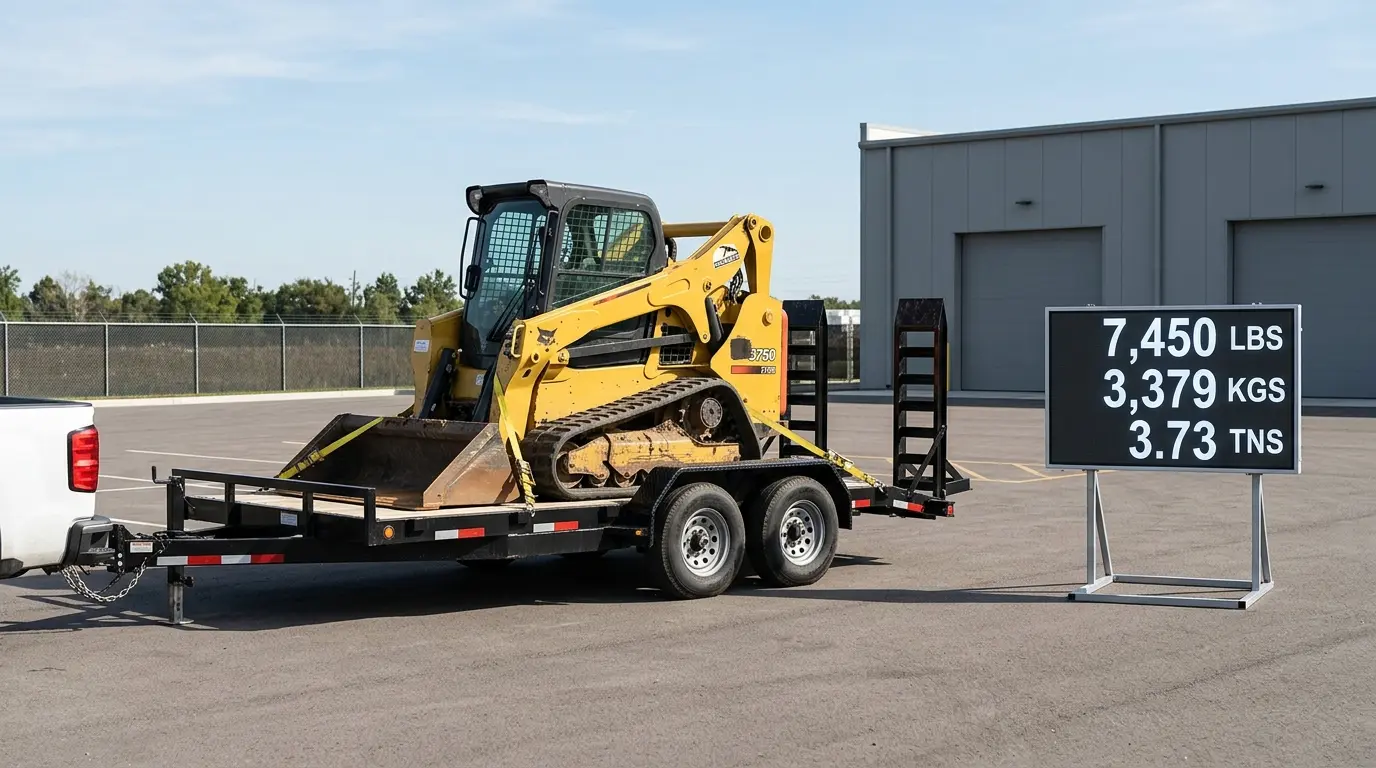
A skid steer typically weighs about 3,000 to 12,000 pounds (1,360 to 5,440 kg), depending on its size, model, equipment, and configuration. For a practical rule of thumb, many commonly used skid steers fall around 7,500 to 8,000 pounds (3,400 to 3,630 kg), although this should not be treated as a universal average for every model.
For example, a compact Bobcat S450 is listed at roughly 5,370 pounds, while a Cat 250 is about 7,829 pounds and a Cat 270 is about 10,441 pounds. This illustrates why the exact model matters when calculating transportation weight.
If you are trying to determine whether a trailer can carry your machine, do not rely on the average alone. You need to consider the skid steer’s published operating weight, the attachment being carried, the trailer’s empty weight, and its GVWR.
How Much Does a Skid Steer Weigh?
Most skid steers weigh somewhere between 3,000 and 12,000 pounds, with many mainstream machines falling in the 5,000- to 10,000-pound range.
A useful size-based estimate is:
| Skid steer size | Approximate weight | Approximate metric weight |
|---|---|---|
| Compact | 3,000–5,500 lb | 1,360–2,495 kg |
| Small/medium | 5,000–7,500 lb | 2,270–3,400 kg |
| Medium | 7,000–9,000 lb | 3,175–4,080 kg |
| Large | 9,000–12,000+ lb | 4,080–5,440+ kg |
These ranges are useful for general planning, but they are not specifications for a particular machine. A manufacturer’s published operating weight should always take priority when transporting or loading equipment.
Skid Steer Weight by Size
Skid steers are built in several frame sizes, so two machines that look similar can have very different weights.
Small skid steers
Compact models are designed for landscaping, residential construction, property maintenance, and other jobs where maneuverability is important.
A Bobcat S450, for example, is listed at 5,370 pounds in one North American specification. Bobcat’s published specifications vary by market and configuration, which is another reason to check the specification sheet for the exact machine being transported.
Small skid steers can therefore be considerably lighter than the commonly quoted 7,500-pound average.
Medium skid steers
Medium machines often fall around 6,000 to 9,000 pounds.
This is a useful range for many general-purpose construction and landscaping applications. However, options such as enclosed cabs, counterweights, larger tires, high-flow hydraulics, and different attachments can change the actual machine weight.
For example, the Cat 250 has a published operating weight of 7,829 pounds, while the Cat 260 is listed at 8,523 pounds.
Large skid steers
Large-frame skid steers can approach or exceed 10,000 pounds.
The Cat 270 is listed at 10,441 pounds, while the Cat 270 XE is listed at 10,847 pounds. These machines are designed for higher-capacity applications and can require substantially more transportation capacity than a compact skid steer.
The important point is that “skid steer” describes a type of loader, not a single size or weight category.
In Pounds, Kilograms and Tons
For quick conversions:
| Weight in pounds | Approx. kilograms | Approx. U.S. short tons |
|---|---|---|
| 3,000 lb | 1,361 kg | 1.5 tons |
| 4,000 lb | 1,814 kg | 2.0 tons |
| 5,000 lb | 2,268 kg | 2.5 tons |
| 6,000 lb | 2,722 kg | 3.0 tons |
| 7,000 lb | 3,175 kg | 3.5 tons |
| 7,500 lb | 3,402 kg | 3.75 tons |
| 8,000 lb | 3,629 kg | 4.0 tons |
| 9,000 lb | 4,082 kg | 4.5 tons |
| 10,000 lb | 4,536 kg | 5.0 tons |
| 12,000 lb | 5,443 kg | 6.0 tons |
In the United States, when people say a skid steer weighs “4 tons,” they generally mean about 8,000 pounds, using the U.S. short ton of 2,000 pounds.
In countries using metric terminology, 4 tonnes means 4,000 kg, or about 8,818 pounds. Those are not the same measurement.
How Much Does a Skid Steer Weigh by Brand?
The manufacturer and model provide a much better answer than a general industry average.
How Much Does a Bobcat Skid Steer Weigh?
Bobcat makes skid steers across a broad range of sizes.
Examples include:
| Bobcat model | Published operating weight |
|---|---|
| S70 | 2,895 lb / 1,312 kg |
| S450 | about 5,370 lb / 2,436 kg* |
| S650 | 8,327 lb / 3,777 kg |
| S770 | 9,173 lb / 4,162 kg |
*Specifications can vary by market and configuration.
The S70 demonstrates why using a single “Bobcat weight” is misleading. A compact S70 is dramatically lighter than a large S770.
How Much Does a Cat Skid Steer Weigh?
Current Cat examples show a similar spread:
| Cat model | Operating weight |
|---|---|
| Cat 250 | 7,829 lb / 3,551 kg |
| Cat 260 | 8,523 lb / 3,866 kg |
| Cat 270 | 10,441 lb / 4,736 kg |
| Cat 270 XE | 10,847 lb / 4,920 kg |
Cat’s specifications define operating weight according to a particular machine configuration, including items such as fluids, an operator, tires, bucket, and other specified equipment. The exact specification note should therefore be checked before using a published number for transport calculations.
How Much Does a Kubota Skid Steer Weigh?
Kubota also offers different skid-steer sizes.
For example, Kubota’s published specifications for the SSV65 and SSV75 list operating weights of approximately 6,790 pounds (3,080 kg) and 8,157 pounds (3,700 kg) respectively.
That puts these examples in the middle of the broader skid-steer weight range.
How Much Does a Skid Steer Weigh With Tracks?
A skid steer normally uses wheels. A machine that uses continuous rubber tracks is generally called a compact track loader (CTL) rather than a conventional skid-steer loader.
People sometimes call these machines “skid steers with tracks,” so the terms can overlap in everyday searches.
Track-equipped machines can also be heavy. For example, the Cat 255 compact track loader has a published operating weight of 9,578 pounds (4,345 kg). Bobcat’s T66 compact track loader has also been listed around 8,560 to 8,900 pounds, depending on the model/configuration and market.
Tracks, undercarriage components, cab configuration, counterweights, and other equipment all affect the final weight.
So if someone asks how much a “tracked skid steer” weighs, it is better to identify the machine as a compact track loader and look up its specific operating weight.
What Is Included in a Skid Steer’s Operating Weight?
One of the biggest sources of confusion is the difference between an advertised operating weight and the bare machine’s weight.
Operating weight is generally a manufacturer-defined configuration that represents the machine ready for operation. Exactly what is included depends on the manufacturer’s specification.
For example, Cat specifies particular operating-weight configurations that include the operator, fluids, bucket, tires, hydraulics, seat, and coupler.
This means you should not automatically compare a manufacturer’s operating weight with a shipping weight from another source.
Two published numbers can differ even when they refer to the same machine because the measurement conditions are different.
When checking a specification sheet, look for the words:
- Operating weight
- Shipping weight
- Transport weight
- Base weight
- Rated operating capacity
- Tipping load
These terms do not mean the same thing.
How Much Does a Skid Steer Weigh With an Attachment?
The attachment can add a significant amount to the total transported weight.
A standard bucket may be part of a manufacturer’s stated operating-weight configuration, while another specification may describe a machine without an attachment. Heavy attachments such as brush cutters, trenchers, augers, grapples, hydraulic breakers, and larger buckets can add substantially more weight.
For transportation, use this basic calculation:
Total loaded weight = skid steer weight + attachment weight + trailer weight + other cargo
For example, suppose a skid steer weighs 7,500 pounds and the attachment weighs 1,000 pounds.
The machine and attachment together weigh:
7,500 + 1,000 = 8,500 pounds
If the trailer weighs another 3,500 pounds empty:
8,500 + 3,500 = 12,000 pounds
The resulting loaded trailer combination is therefore about 12,000 pounds, before considering anything else being carried.
This is why knowing only the skid steer’s weight is not enough when planning transportation.
How Much Does a Skid Steer Weigh With a Trailer?
There is no single answer because trailers have different empty weights.
For example, some 14,000-pound equipment trailers have empty weights around 2,600 to 3,700 pounds, while heavier equipment or dump trailers can weigh more than 4,000 pounds.
A practical calculation is:
Skid steer operating weight + attachment weight + trailer empty weight = loaded trailer weight
Consider a 7,500-pound skid steer with a 1,000-pound attachment on a 3,000-pound equipment trailer:
7,500 + 1,000 + 3,000 = 11,500 pounds
The trailer’s GVWR must also be considered. A 14,000-pound GVWR trailer does not mean you can put 14,000 pounds of equipment on it. GVWR includes the trailer itself.
For example, a 14,000-pound GVWR trailer with a 3,000-pound empty weight has approximately 11,000 pounds of theoretical payload capacity, assuming the manufacturer’s stated ratings and configuration.
Always use the actual trailer’s VIN plate, manufacturer’s specifications, and applicable towing limits rather than relying on a general example.
Operating Weight vs. Rated Operating Capacity vs. Tipping Load
These three terms are easy to confuse.
Operating weight is the weight of the machine in the manufacturer’s specified operating configuration.
Rated operating capacity (ROC) describes how much load the loader is designed to handle under a specified rating method. It is not the machine’s weight.
Tipping load is a different performance measurement related to the load at which the machine reaches a specified tipping condition.
For example, Cat lists the 250 at 7,829 pounds operating weight, 2,689 pounds rated operating capacity, and 5,378 pounds tipping load.
Those numbers describe completely different characteristics.
A common mistake is to see a 2,689-pound figure in a skid-steer specification and assume the machine weighs 2,689 pounds. It does not.
What Factors Affect Skid Steer Weight?
Several factors can change the actual weight of a machine.
Machine size
A compact machine will generally weigh considerably less than a large-frame loader.
Cab configuration
An enclosed cab, air conditioning, additional glass, doors, and related equipment can add weight compared with a simpler open configuration.
Counterweights
Counterweights increase machine weight and can change rated operating capacity.
Tires and wheels
Different tire sizes and configurations can change the machine’s final weight.
Attachments
The attachment can add hundreds or even thousands of pounds depending on its type and size.
Tracks or undercarriage
Compact track loaders use a different undercarriage from wheeled skid steers and can have substantially different operating weights.
Fuel and fluids
Manufacturer definitions may include full fluids, but a shipping or bare-machine specification may be different.
Optional equipment
High-flow hydraulics, additional protective equipment, specialized cabs, ride-control equipment, and other options can affect weight.
How to Find the Exact Weight of Your Skid Steer
If you need the weight for transportation, do not use an internet average if you can avoid it.
Start with the exact model and serial number.
1. Identify the model
Find the model designation on the machine, specification plate, owner’s manual, or purchase documentation.
2. Check the manufacturer’s specification
Look specifically for operating weight and read the notes below the specification.
The notes matter because the published figure may assume a specific bucket, operator weight, tire configuration, or cab arrangement.
3. Add the attachment
If your attachment is not included in the stated configuration, obtain its weight and add it separately.
4. Check the trailer
Find the trailer’s:
- Empty weight
- GVWR
- GAWR
- Payload capacity
Do not confuse GVWR with payload capacity.
5. Weigh the loaded combination when necessary
If the exact loaded weight is important, a certified public scale or appropriate commercial weigh station can provide a real-world measurement.
This is particularly useful when the machine is heavily modified or equipped with multiple accessories.
Common Skid Steer Weight Mistakes
Using the rated operating capacity as the machine weight
ROC tells you about lifting capacity, not how heavy the machine itself is.
Forgetting the attachment
A heavy attachment can substantially change the transported weight.
Using shipping weight instead of operating weight
These figures can represent different configurations.
Ignoring the trailer’s own weight
The towing vehicle must deal with the complete trailer combination, not just the machine sitting on the deck.
Assuming every 14,000-pound trailer can carry 14,000 pounds of equipment
The trailer’s GVWR includes the trailer itself. Payload is lower than GVWR by approximately the trailer’s empty weight.
Assuming tracked and wheeled machines weigh the same
Compact track loaders use a different undercarriage and may have significantly different specifications.
What Is the Average Weight of a Skid Steer?
A commonly cited practical average is approximately 7,500 pounds, or about 3,400 kg.
However, this should be treated as a rule-of-thumb estimate rather than a statistically universal average. The result changes depending on which manufacturers, model years, frame sizes, and configurations are included in the sample.
For a quick estimate, 7,500 to 8,000 pounds is a useful starting point for a general-purpose skid steer.
For transportation, purchasing, or legal weight calculations, use the actual model’s specification instead.
Bottom Line
A skid steer can weigh anywhere from roughly 3,000 to 12,000 pounds or more, depending on its size and configuration. Many common machines fall around 7,500 to 8,000 pounds, but compact models can be much lighter and large-frame models can exceed 10,000 pounds.
If you are calculating transport weight, the most important number is not the generic average. Find the machine’s exact operating weight, then add the attachment and trailer weight.
For example:
7,500-lb skid steer + 1,000-lb attachment + 3,000-lb trailer = 11,500-lb loaded trailer combination.
That figure can then be compared with the trailer’s payload/GVWR and the tow vehicle’s applicable ratings.
FAQ’s
How much does a skid steer weigh on average?
A practical estimate is about 7,500 to 8,000 pounds, or approximately 3,400 to 3,630 kg, but the actual weight varies considerably by model and configuration.
How much does a skid steer weigh in pounds?
Most skid steers fall somewhere around 3,000 to 12,000+ pounds, with many commonly used models between 5,000 and 10,000 pounds.
How much does a skid steer weigh in kg?
A typical general-purpose skid steer may weigh around 3,400 to 3,630 kg, while the broader range can be approximately 1,360 to 5,440+ kg.
How much does a skid steer weigh in tons?
An 8,000-pound skid steer weighs about 4 U.S. short tons. The exact conversion depends on the machine’s actual weight.
How much does a Bobcat skid steer weigh?
Bobcat skid steers vary widely. Examples range from the compact S70 at about 2,895 pounds to larger models such as the S770 at roughly 9,173 pounds.
How much does a Cat skid steer weigh?
Current Cat examples include the 250 at 7,829 pounds, the 260 at 8,523 pounds, and the 270 at 10,441 pounds.
How much does a Kubota skid steer weigh?
Published Kubota examples include the SSV65 at about 6,790 pounds and the SSV75 at about 8,157 pounds.
How much does a skid steer weigh with tracks?
A tracked version is normally called a compact track loader. For example, Cat’s 255 compact track loader has a published operating weight of 9,578 pounds.
How much does a skid steer weigh with a trailer?
Add the skid steer’s weight, attachment weight, and trailer empty weight. A 7,500-pound machine plus a 1,000-pound attachment and 3,000-pound trailer would total approximately 11,500 pounds.
Does a skid steer’s bucket count toward its weight?
It depends on the manufacturer’s definition of operating weight. Some published operating-weight specifications include a particular bucket and configuration, so always read the manufacturer’s specification notes.
Consistent, proactive inspection intervals extend vehicle reliability and resale value far more cost-effectively than reactive mechanical overhauls.

admin
admin is an automotive writer and technical editor at AutoSPrime, specializing in vehicle reliability and maintenance engineering.