If you are wondering what does FOB mean in shipping, FOB stands for Free On Board. It is a trade and shipping term used to identify an important point in a transaction: where delivery responsibility and the risk of loss or damage move from the seller to the buyer.
However, FOB does not mean exactly the same thing in every situation. In U.S. domestic sales, you may see terms such as FOB shipping point or FOB destination. In international trade, FOB is also an official Incoterms® 2020 rule with a more specific meaning that applies to sea and inland waterway transport.
That distinction matters. A purchase order that simply says “FOB” may not tell you enough about who pays the freight, who bears transit risk, or when ownership is transferred. The complete wording and the governing contract determine the result.
What Does FOB Mean in Shipping?
FOB means Free On Board.
In general shipping and commercial usage, FOB identifies a point at which important delivery responsibilities shift between the seller and buyer. The exact effect depends on the legal or contractual framework being used.
In a typical U.S. domestic transaction, the two terms you are most likely to encounter are:
- FOB shipping point, also called FOB origin
- FOB destination
With FOB shipping point, the buyer generally takes responsibility for the goods once the seller completes the required shipment at the shipping point. With FOB destination, the seller generally remains responsible until the goods reach the specified destination.
The U.S. Uniform Commercial Code specifically describes FOB at a named place as a delivery term. Under UCC § 2-319, FOB at the place of shipment places the seller’s responsibility for putting the goods into the carrier’s possession at the shipment location, while FOB at the destination requires the seller to transport the goods to that destination at the seller’s expense and risk.
The exact contract language still matters, particularly when a transaction involves unusual delivery arrangements.
Way to Understand FOB
Think of FOB as identifying the handoff point.
Before that point, one party has the contractual responsibility. After that point, responsibility shifts according to the agreed terms.
For example, suppose a machinery supplier sells a $25,000 industrial component.
If the agreement is FOB shipping point, the buyer may become responsible for the shipment once it leaves the seller’s shipping location.
If the agreement is FOB destination, the seller remains responsible until the machinery reaches the agreed destination.
The phrase alone is not enough, though. You should also check whether the agreement specifies freight prepaid, freight collect, a named location, or an applicable Incoterms® version.
FOB Shipping Point vs. FOB Destination
The distinction between FOB shipping point and FOB destination is one of the most important concepts for buyers and sellers to understand.
| Term | General transfer point in U.S. domestic usage | Typical transit responsibility | Typical freight arrangement |
|---|---|---|---|
| FOB Shipping Point | Seller’s shipping location | Buyer after shipment according to the contract | Buyer generally pays |
| FOB Destination | Buyer’s specified destination | Seller until destination | Seller generally pays |
These are simplified descriptions of common U.S. usage. The actual contract and applicable law should be checked for a particular transaction.
FOB Shipping Point
FOB shipping point means the delivery obligation is completed at the seller’s shipping point under the applicable agreement.
In a conventional shipment contract, the seller delivers the goods to the carrier at the shipping location, and the buyer assumes the relevant transit risk from that point.
This can affect several practical issues:
- Who is responsible if the shipment is damaged in transit
- Who arranges or pays for transportation
- Who handles a freight claim
- When the buyer records the goods in inventory
- When the seller records the sale under applicable accounting rules
For example, imagine a company buying replacement parts for a fleet of commercial vehicles. The purchase order says FOB shipping point, and the seller hands the parts to the carrier at its warehouse.
If the goods are damaged after the contractual transfer point, the buyer may bear the loss and need to pursue the carrier or applicable insurance coverage.
FOB Destination
FOB destination generally means the seller remains responsible for transporting the goods to the specified destination.
Under UCC § 2-319, when goods are FOB the place of destination, the seller must transport them there at the seller’s expense and risk and tender delivery at that location.
For a buyer, this can make the transaction easier to manage because the seller retains responsibility during the transportation period.
For example, suppose a manufacturer orders a large machine and the sales agreement specifies FOB destination at the manufacturer’s facility. If the machine is damaged during transportation before reaching that destination, the seller generally retains the relevant delivery risk under the agreement.
Why the distinction matters
The biggest mistake is treating FOB as if it simply means “the seller pays shipping.”
It does not.
FOB identifies a delivery point, while freight prepaid or freight collect can separately determine who initially pays the carrier.
That is why you should read the entire shipping term rather than looking only for the letters FOB.
What Does FOB Mean in International Shipping?
In international trade, FOB has a specific meaning under Incoterms® 2020.
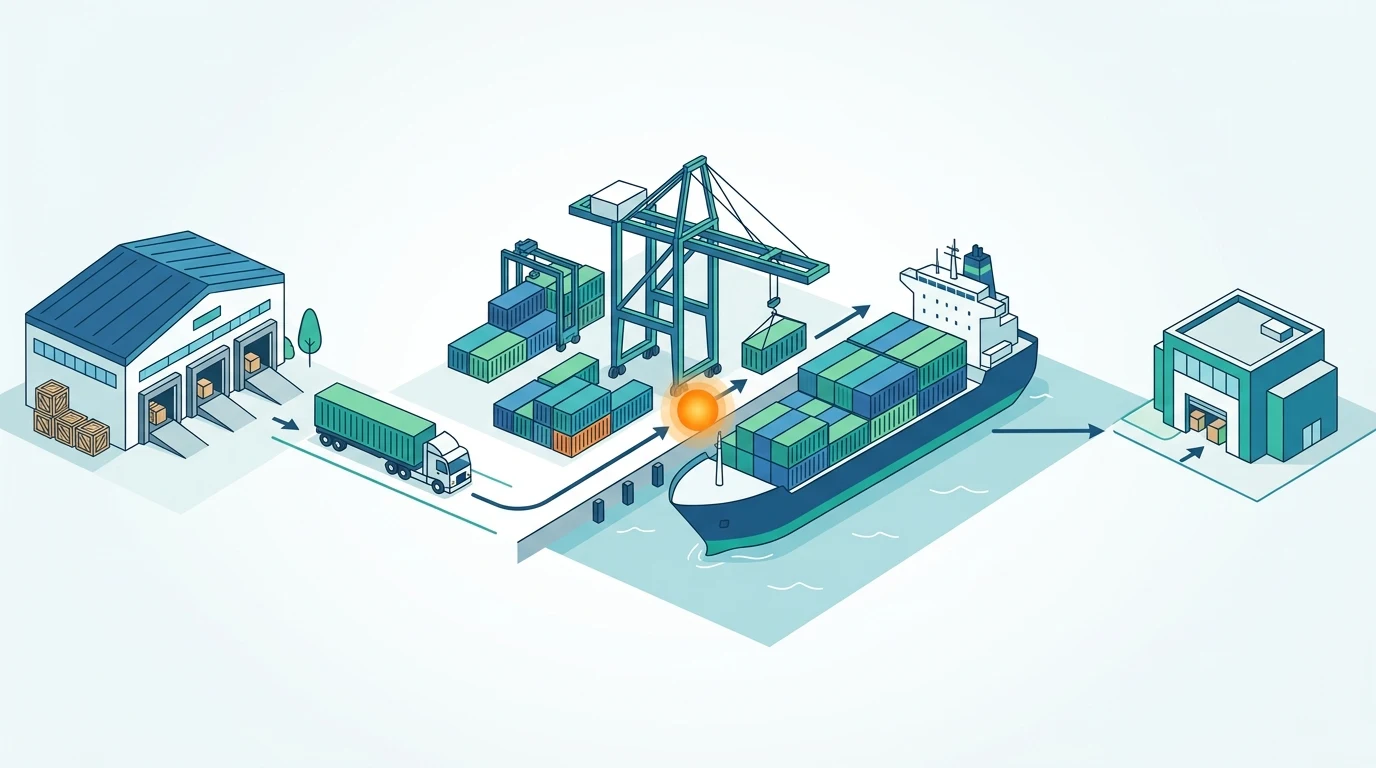
Under the ICC’s FOB rule, the seller delivers the goods on board the vessel nominated by the buyer at the named port of shipment. The risk of loss or damage transfers when the goods are on board the vessel, and the buyer bears the costs from that point onward.
This is different from the broad U.S. domestic use of “FOB shipping point.”
FOB under Incoterms® 2020
The international form is normally written along the lines of:
FOB [named port of shipment] Incoterms® 2020
For example:
FOB Port of Los Angeles Incoterms® 2020
The named port is important because it identifies where the seller’s delivery obligation is completed under the FOB rule.
Under this international rule, the seller is responsible for the required obligations up to the point of delivery on board the vessel. After delivery under the rule, the buyer assumes the relevant risk and costs.
The buyer generally arranges the main carriage and bears costs arising after the delivery point.
FOB is not an all-transport Incoterm
One of the most important details about international FOB is that the ICC classifies it among the rules for sea and inland waterway transport.
The ICC states that FOB should be used when the parties intend the goods to be delivered by placing them on board a vessel. If goods are handed to a carrier at a container terminal before they are on board the vessel, the ICC indicates that FCA (Free Carrier) should be considered instead.
This matters particularly for containerized cargo.
A business importing machinery, automotive components, motorcycles, or other containerized goods should therefore avoid automatically writing “FOB” simply because the shipment ultimately travels by ocean.
The correct Incoterm should reflect the actual delivery point and transport arrangement.
FOB International Shipping vs. U.S. Domestic FOB
The word FOB can create confusion because it is used in more than one commercial context.
| Feature | U.S. domestic FOB usage | ICC Incoterms® 2020 FOB |
|---|---|---|
| Common wording | FOB shipping point / FOB destination | FOB named port |
| Main purpose | Defines delivery responsibility under the applicable sales contract | Defines seller/buyer obligations, costs, and risk |
| Transport | Commonly used in domestic freight transactions | Sea and inland waterway transport |
| Delivery point | Shipping point or destination | Goods loaded on board the nominated vessel |
| Title/ownership | May be addressed under applicable sales law and contract | Not determined by Incoterms alone |
| Main reference | UCC and sales contract | ICC Incoterms® 2020 |
The last row is especially important.
Incoterms® do not themselves determine transfer of ownership or title. The ICC explicitly states that property/title/ownership is outside the scope of the Incoterms® rules and should be addressed in the sales contract or applicable law.
Therefore, avoid automatically writing that “FOB always means title transfers at the same moment.” The answer depends on the framework and contract.
Who Pays Shipping Under FOB?
FOB and freight payment are related, but they should not be treated as identical concepts.
You may encounter combinations such as:
- FOB shipping point, freight collect
- FOB shipping point, freight prepaid
- FOB destination, freight prepaid
- FOB destination, freight collect
Freight Collect
Freight collect generally means the receiving party is responsible for paying the carrier’s transportation charge.
For example, under a conventional FOB shipping point, freight collect arrangement, the buyer assumes the relevant responsibility at the shipping point and pays the carrier.
But freight collect does not automatically determine who bears the risk of loss.
Freight Prepaid
Freight prepaid means the shipper initially pays the carrier.
That does not necessarily mean the shipper ultimately bears the economic cost or the transit risk.
For example, under FOB shipping point, freight prepaid, the seller might pay the carrier initially even though the buyer has assumed the relevant responsibility for the goods in transit. The seller could recover the freight cost from the buyer according to the agreement.
Freight Prepaid and Add
You may also see freight prepaid and add.
In this arrangement, the seller pays the carrier initially and then adds the applicable freight charge to the buyer’s invoice.
This is why reading the complete freight term is important.
What Does FOB Mean on a Purchase Order?
On a purchase order, FOB tells the seller and buyer how the agreed delivery arrangement is structured.
For a purchasing department, the FOB term can affect:
- Transportation responsibility
- Risk during transit
- Freight charges
- Receiving procedures
- Inventory timing
- Damage claims
- Carrier arrangements
- Contract administration
For example, a purchase order might say:
100 hydraulic pumps — FOB Shipping Point, Freight Collect
That wording provides more information than simply writing “FOB.”
The purchasing team can determine that the shipment is subject to an FOB shipping-point arrangement and that freight is collected from the buyer.
For international transactions, a purchase order should be even more precise. A buyer might specify:
FOB Shanghai, Incoterms® 2020
The named port and Incoterms® version remove ambiguity about which international rule the parties intend to use.
The ICC itself recommends incorporating the selected rule together with the named port, place, or point and the applicable Incoterms® version.
What Does FOB Price Mean?
FOB price generally refers to a price quoted using an FOB delivery term.
The exact meaning depends on the context.
In an international Incoterms® transaction, a price quoted as FOB [named port] Incoterms® 2020 generally covers the seller’s obligations and costs up to the point where the goods are delivered on board the vessel at the named port, subject to the detailed rule.
It does not mean the buyer receives the goods at the final destination with every transportation expense included.
For example, if a machinery supplier quotes:
$40,000 FOB Port of Shanghai
the buyer should not automatically assume that $40,000 includes:
- Ocean freight to the destination country
- Marine insurance
- Destination port charges
- Import duties
- Import taxes
- Inland transportation to the buyer’s warehouse
Those costs depend on the agreed contract and applicable shipping arrangements.
A buyer should therefore ask for a complete landed-cost calculation rather than comparing FOB prices alone.
What Does FOB Mean in Accounting?
FOB terms can affect accounting because they help determine when goods are considered delivered under the applicable sales arrangement.
In traditional U.S. accounting examples:
FOB shipping point generally means the buyer records the goods when the shipment occurs, while the seller records the sale at that point, assuming the other requirements for recognition are met.
FOB destination generally means the seller retains the goods in transit until delivery, with the buyer recording the purchase when delivery occurs.
This affects inventory cutoffs, especially around the end of an accounting period.
Example
Imagine a company purchases $50,000 worth of equipment on December 30.
The goods ship on December 30 but arrive on January 3.
If the transaction is FOB shipping point, the buyer may need to include the goods in its year-end inventory, depending on the applicable accounting framework and contract.
If it is FOB destination, the seller may continue to report the goods as inventory while they are in transit until the required delivery occurs.
Accounting treatment can become more complicated in real transactions, so businesses should apply the applicable accounting standards and their contract terms rather than relying on the FOB label alone.
Does FOB Mean Free Shipping?
No. FOB does not mean free shipping.
The word “free” in Free On Board does not mean that transportation is free of charge.
Instead, FOB describes the seller’s delivery obligation and the point at which the relevant costs and risks shift under the applicable rule.
In international FOB under Incoterms® 2020, the buyer bears costs from the point at which the goods have been delivered on board the vessel.
So if a supplier says an item is FOB Shanghai, that does not mean the supplier will ship the item to your warehouse at no additional transportation cost.
The buyer may still have to pay for ocean transportation and other costs after the FOB delivery point.
What Does FOB Mean in Shipping Tracking?
FOB is not a tracking status.
If you see FOB on an invoice, purchase order, freight document, or logistics record, it normally refers to the agreed shipping or delivery term.
A carrier’s tracking page may separately show statuses such as:
- Shipment created
- Picked up
- In transit
- Arrived at terminal
- Out for delivery
- Delivered
FOB tells you how responsibility is allocated under the transaction; the carrier’s tracking system tells you where the shipment is in the transportation process.
For example, a purchase order could be FOB shipping point while the carrier tracking page says “in transit.” The FOB term helps establish which party bears the contractual responsibility during that transit period; it does not tell you the physical location of the shipment.
Practical FOB Examples for Cars, Parts, and Machinery
FOB becomes easier to understand when applied to products that businesses commonly buy and sell.
Example 1: Automotive parts
A parts manufacturer sells brake components to a distributor under FOB shipping point.
The seller prepares the order and hands it to the carrier at the agreed shipping location.
Once the applicable transfer point is reached, the buyer assumes the relevant transit responsibility. If the goods are later damaged, the parties look to the purchase agreement, carrier contract, insurance, and applicable law to determine how the claim should be handled.
Example 2: Industrial machinery
A machinery buyer orders a $75,000 piece of equipment under FOB destination.
The seller arranges delivery to the buyer’s specified facility and retains the relevant delivery risk until the destination is reached.
If the equipment is damaged during transit before delivery, the seller generally remains responsible under the FOB destination arrangement.
Example 3: International motorcycle shipment
A buyer imports motorcycles under:
FOB Ningbo, Incoterms® 2020
This is an international FOB arrangement.
The seller’s delivery point is the named port, and the goods must be delivered on board the vessel nominated by the buyer. Once the goods have been delivered according to the FOB rule, the relevant risk and costs move to the buyer.
The buyer should separately budget for the costs after that point, such as main carriage, destination handling, import clearance, duties, taxes, and inland delivery where applicable.
Example 4: Containerized machinery
Suppose a machinery supplier loads a container at its factory, and the container is then delivered to a terminal before being loaded onto the vessel.
A buyer should not assume that international Incoterms® FOB is automatically the correct rule merely because the final transportation is by ocean.
The ICC explains that when goods are handed to a carrier at a container terminal before being placed on board the vessel, FCA may be more appropriate.
That distinction can prevent misunderstandings about exactly where risk transfers.
Common FOB Mistakes to Avoid
Mistake 1: Assuming FOB means free shipping
It does not. FOB is a delivery term, not a promise that transportation costs are zero.
Mistake 2: Treating freight payment as the same as risk
A seller can pay the freight bill while the buyer carries the relevant transit risk, depending on the agreed terms.
Mistake 3: Using international FOB for every type of shipment
Under Incoterms® 2020, FOB belongs to the sea and inland-waterway group and is tied to delivery on board a vessel.
Mistake 4: Assuming Incoterms® determine ownership
They do not. The ICC expressly states that Incoterms® rules do not determine transfer of property, title, or ownership.
Mistake 5: Writing only “FOB”
A purchase order or sales agreement should provide enough detail to identify the intended arrangement.
For international transactions, include the named place or port and the applicable Incoterms® version.
Mistake 6: Comparing FOB prices without calculating landed cost
A lower FOB quotation may still result in a higher total acquisition cost once transportation, insurance, customs, duties, destination charges, and inland delivery are included.
Mistake 7: Ignoring the purchase order
The purchase order, sales contract, invoice, and shipping documents should be consistent. If they use conflicting delivery terms, the parties may face unnecessary disputes.
How to Read an FOB Term Correctly
When you encounter FOB on a commercial document, work through these questions:
1. What framework applies?
Is this a U.S. domestic transaction using FOB shipping point/destination terminology, or an international transaction using an ICC Incoterms® rule?
2. What location is named?
Look for a shipping point, destination, port, terminal, or other named place.
3. Where does delivery occur?
Identify the exact event that completes the seller’s delivery obligation.
4. Who bears transit risk?
Determine which party bears the relevant risk after the delivery point.
5. Who pays the freight?
Check whether the agreement says freight prepaid, collect, prepaid and add, or another arrangement.
6. What happens to title or ownership?
Do not assume this is automatically determined by Incoterms®. Check the sales contract and applicable law.
7. What additional costs remain?
For international purchases, calculate the full landed cost rather than relying only on the FOB quotation.
This approach is particularly useful when purchasing expensive automotive parts, motorcycles, machinery, equipment, or other goods where a shipping mistake can create a substantial financial dispute.
The Bottom Line
FOB means Free On Board, but its practical meaning depends on the context.
In U.S. domestic commerce, FOB shipping point and FOB destination are commonly used to identify where the seller’s delivery responsibility ends and the buyer’s begins. In international trade, FOB under Incoterms® 2020 is a specific rule for sea and inland-waterway transport, with delivery occurring when the goods are placed on board the buyer-nominated vessel at the named port of shipment.
FOB also does not simply mean “free shipping.” Freight payment, transit risk, and ownership are related but separate issues that should be established from the complete contract and applicable rules.
If you see FOB on a purchase order, invoice, or shipping document, do not stop at the acronym. Check the named place, the exact FOB wording, the freight arrangement, the applicable legal or Incoterms® framework, and the point at which delivery occurs. That is what tells you what the term actually means for the transaction.
FAQ’s
What does FOB stand for?
FOB stands for Free On Board. It is a shipping and trade term used to identify a delivery point and allocate certain responsibilities between seller and buyer.
What does FOB mean in shipping?
FOB means Free On Board. In general commercial use, it identifies where delivery responsibility and relevant risk transfer between seller and buyer. Its exact meaning depends on whether the transaction uses domestic FOB terminology or the ICC’s Incoterms® rules.
What does FOB mean in business?
In business, FOB is a delivery term that helps establish responsibility for goods during transportation. It can affect freight costs, risk, inventory accounting, and claims when goods are lost or damaged.
What does FOB mean in a purchase order?
FOB on a purchase order identifies the agreed delivery arrangement. The purchase order should make clear whether the term is FOB shipping point, FOB destination, or an international Incoterms® rule such as FOB with a named port.
What does FOB price mean?
FOB price is a price quoted under an FOB delivery arrangement. In international trade, an FOB price generally covers the seller’s obligations up to delivery on board the vessel at the named port, while costs after that point are generally the buyer’s responsibility under the Incoterms® rule.
Does FOB mean free shipping?
No. FOB does not mean that shipping is free. “Free On Board” is the name of the trade term and does not mean that transportation has no cost.
What does FOB mean in accounting?
FOB can affect when a seller records a sale and when a buyer records inventory, particularly under traditional FOB shipping point and FOB destination arrangements. The exact accounting treatment should follow the applicable accounting framework and contract.
What does FOB mean in shipping tracking?
FOB is not normally a tracking status. It identifies the agreed shipping or delivery term, while a carrier’s tracking system reports the shipment’s physical transportation status.
Is FOB the same as FOB shipping point?
Not always. “FOB shipping point” is a common U.S. domestic delivery term. International FOB under Incoterms® 2020 has a specific meaning and is used for sea and inland-waterway transport.
Does FOB include insurance?
Not necessarily. International FOB does not require the seller to provide cargo insurance for the buyer after the FOB delivery point. Buyers should determine their insurance needs based on the contract, shipment, and applicable risk allocation.
Consistent, proactive inspection intervals extend vehicle reliability and resale value far more cost-effectively than reactive mechanical overhauls.

admin
admin is an automotive writer and technical editor at AutoSPrime, specializing in vehicle reliability and maintenance engineering.